Most Translators Fail This Test on Their First Try. Here's What They Miss.
TL;DR: GloGround's Translation Pair Test evaluates your ability to translate between your language pair with accuracy and natural fluency. The section most candidates underestimate is cultural adaptation.
Most Translators Fail This Test on Their First Try. Here's What They Miss.
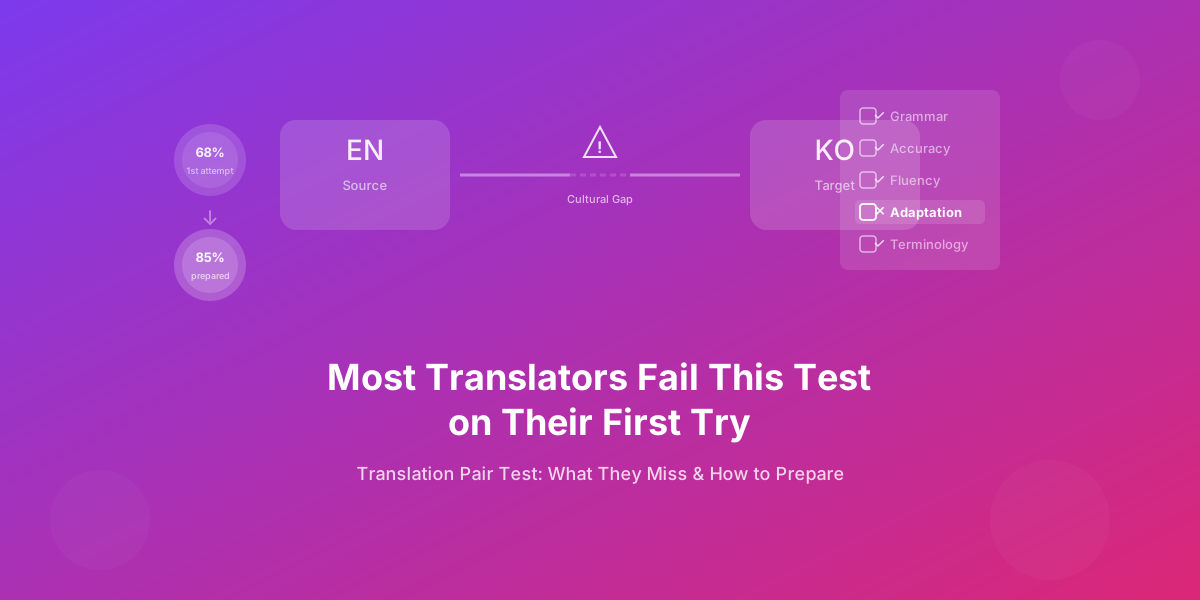
GloGround's Translation Pair Test has three sections, and the one that trips up most candidates isn't the specialized translation — it's the cultural adaptation section, where textbook accuracy isn't enough.
That surprises many translators at first.
After all, specialized translation sounds like the hardest part. Technical language, domain terminology, and subject-specific phrasing seem like the obvious challenge. But in practice, many candidates do reasonably well there and still lose points where they least expect it: on translations that are correct on paper, yet do not feel natural, persuasive, or fully appropriate for the target reader.
That is why this test matters.
The Translation Pair Test is not only measuring whether you understand both languages. It is measuring whether you can create a translation that works. That means preserving meaning, handling terminology responsibly, and making choices that feel right for the audience, context, and purpose of the text.
If you have already passed the Native Language Test, this is your next step toward becoming a certified translator on GloGround. And if you approach it with the right preparation, it becomes much more manageable.
What the Translation Pair Test Is
The Translation Pair Test is the second stage of GloGround's certification process.
Where the Native Language Test focuses on your command of one language — grammar, vocabulary, cultural knowledge, and professional writing — the Translation Pair Test evaluates something different: how well you translate between two languages in practice.
That distinction matters.
A translator may have strong native-language writing skills and still struggle when moving meaning across languages. Translation requires more than fluency. It requires judgment. You need to decide what should stay close to the source, what needs to be restructured, and what needs to be adapted for the target audience without losing the original intent.
This is why the test is built around actual translation performance rather than general language knowledge alone.
If you have not completed the first stage yet, our guide on How to Pass GloGround's Native Language Test is the best place to start. And if you are still getting settled on the platform, Your First 48 Hours on GloGround and Welcome to GloGround offer a useful foundation.
The Three Sections of the Test
The Translation Pair Test evaluates candidates across three areas:
- general translation
- specialized translation
- cultural adaptation
Each one measures a different part of translation ability, and together they give a much more complete picture of your readiness.
1. General Translation
This section tests your ability to handle everyday professional translation clearly and accurately.
The challenge here is not usually rare vocabulary or technical jargon. It is whether you can carry meaning cleanly, maintain tone, and produce target-language writing that reads naturally. Many candidates lose points by translating too closely to the source structure, even when the resulting sentence feels stiff or slightly unnatural.
2. Specialized Translation
This section evaluates how well you work with more domain-specific content.
Depending on your language pair and test structure, this may include terminology, more formal phrasing, or context where subject knowledge matters. Strong performance here depends on precision, consistency, and the ability to recognize which terms need careful handling rather than approximate equivalents.
Specialized translation is demanding, but many candidates expect that. As a result, they often prepare for it more seriously.
3. Cultural Adaptation
This is the section most candidates underestimate.
Cultural adaptation asks whether you can go beyond literal meaning and produce language that feels natural and appropriate for the intended reader. The translation may be technically accurate, yet still feel off in tone, too direct, too formal, too vague, or too tied to source-language structure.
This is often where a good translator separates themselves from a merely bilingual one.
What Most Candidates Miss
The most common mistake in the Translation Pair Test is not misunderstanding vocabulary. It is misunderstanding what counts as a successful translation.
Many candidates assume that if the meaning is technically preserved, the answer is probably strong enough. But translation quality is not measured only by correctness. It is also measured by usability.
A sentence can be accurate and still sound translated. It can preserve the message but miss the audience. It can be grammatically correct yet feel unnatural to a native reader.
That is especially true in cultural adaptation.
For example, some source-language phrases rely on tone, politeness, emotional distance, or implied context in ways that do not transfer directly. If you carry them over too literally, the translation may feel awkward or mismatched, even if every word is "correct."
This is why candidates often leave the test feeling confident, only to discover later that they were too source-bound in their choices.
How to Prepare More Effectively
The best preparation for the Translation Pair Test is not memorizing rules in isolation. It is practicing the kind of decisions real translators make.
Practice Short, Realistic Translation Passages
Work with short texts that resemble actual client material rather than only textbook examples. Translate them, step away, then reread them from the perspective of a native target-language reader.
Ask yourself:
- Does this sound natural?
- Would a client publish this as-is?
- Is the tone appropriate?
- Did I preserve the meaning without copying the source structure too closely?
This kind of self-review is much closer to the test than passive study alone.
Read as the Target Reader, Not Just as the Translator
Many candidates review their work while still hearing the source text in their head.
That makes it harder to spot awkward phrasing.
A better habit is to read your translation as if you had never seen the original. Would the sentence feel clear and purposeful on its own? Would the reader understand it easily? Would it sound like something originally written in the target language?
This shift is especially important for cultural adaptation.
Keep Terminology Consistent
In specialized translation, one of the fastest ways to lose trust is inconsistency.
If the same source term appears more than once, your target-language choice should usually stay stable unless the context genuinely changes. This is not only a linguistic issue. It is a professional one.
Build the habit of tracking your key terms and checking whether your choices remain aligned throughout the text.
Avoid Over-Respecting the Source
Strong translators respect the source text, but they do not become trapped by it.
If your translation sounds unnatural simply because you tried to preserve the original sentence shape too closely, the result may be faithful but ineffective. The goal is not to mimic the source language. The goal is to carry the intended meaning successfully into the target language.
That is where many first-attempt candidates fall short.
A Better Test-Day Strategy
Preparation matters, but so does your approach on the day of the test.
Start by choosing a time when you can focus fully. Do not treat this as something to rush between other tasks. Translation requires concentration, especially when tone and nuance are being evaluated.
As you work, keep three things in mind:
- accuracy matters
- naturalness matters
- reader fit matters
If you have to choose between a literal version and one that better serves the target audience while preserving meaning, the second is often the stronger translation.
And if a sentence feels slightly awkward when you reread it, trust that instinct. In many cases, that discomfort is a useful signal that the wording still needs adjustment.
If You Don't Pass the First Time
Not passing on the first attempt does not mean you are not capable of becoming a strong translator.
It usually means one of two things: either you were not fully prepared for the demands of the test, or you were stronger in one area than another and need a more balanced performance overall.
The good news is that the Translation Pair Test can be retaken after a waiting period. During Early Access, retests are free, which gives candidates room to learn from the first attempt without extra cost pressure.
If you do need to retake it, approach the result as feedback rather than failure. Review where your translation may have been too literal, inconsistent, or not fully adapted for the reader. Those are professional growth points, not dead ends.
Why This Step Matters
The Translation Pair Test is an important part of becoming a certified translator on GloGround because it measures what clients actually care about: can you translate in a way that is accurate, natural, and appropriate for the job?
That matters whether you want to work in general content or move into more advanced specialization later.
It also matters because GloGround is built around professional trust. Certification helps clients identify translators who have demonstrated readiness, and the platform's 0% commission structure means that once you begin winning work, you keep 100% of your project earnings.
That combination — visible professional standards and fairer economics — is what makes certification worth taking seriously.
The Most Important Shift
If there is one idea to carry into this test, it is this:
Do not aim only for accuracy. Aim for a translation that works.
That means language that is clear, context-aware, audience-appropriate, and natural in the target language. It means respecting terminology without sacrificing readability. And it means recognizing that sometimes the hardest part of translation is not the difficult word — it is knowing when a sentence needs to live differently in another language.
That is what the best candidates understand.
If you have not taken the first step yet, start with the Native Language Test. If you have already passed it, this is your moment to move forward: create your account today.
Frequently Asked Questions
What is the Translation Pair Test?▼
It is the second stage of GloGround's certification process, evaluating your ability to translate accurately and naturally between your source and target languages across general, specialized, and cultural adaptation tasks.
How is it different from the Native Language Test?▼
The Native Language Test assesses your proficiency in a single language. The Translation Pair Test evaluates how well you translate between two languages — including meaning, tone, terminology, and cultural fit.
What section do most people struggle with?▼
Cultural adaptation. Many translators produce technically accurate work that still feels unnatural to native readers. This section tests whether you can go beyond literal accuracy to create translations that truly work for the target audience.
Can I retake it if I don't pass?▼
Yes. You can retake the Translation Pair Test after a waiting period. During Early Access, retests are free. Your results highlight areas for improvement so you can prepare more effectively.
Related Posts
Your First 48 Hours on GloGround: A Step-by-Step Onboarding Guide
Everything you need to do in your first two days on GloGround — from account setup and profile optimization to certification and landing your first project.
How to Pass GloGround's Native Language Test: Preparation Tips That Work
A practical guide to GloGround's native language proficiency test — what it covers, how it is scored, and the specific preparation strategies that help translators pass on their first attempt.
5 Reasons Your Weekend Is the Perfect Time to Start Your Translation Career
Already thinking about freelance translation? Here is why this weekend might be the ideal time to take your first step — from creating your profile to passing your first certification test.