Your Company Is Losing Money on Translation. You Just Don't Know How Much Yet.
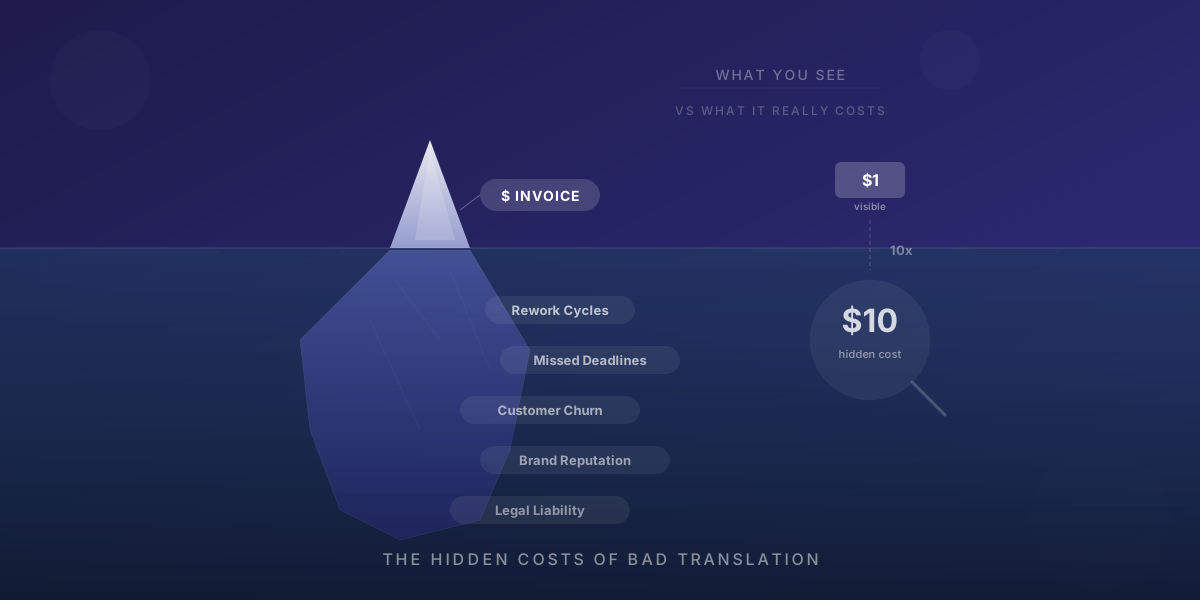
TL;DR: The invoice is only the beginning. Bad translation costs businesses 5-10x more through rework, delays, customer loss, and compliance risk. Hiring certified specialists from the start is the most cost-effective approach.
Your Company Is Losing Money on Translation. You Just Don't Know How Much Yet.
Most businesses measure translation cost by the invoice amount, but the real expense — rework, delayed launches, lost customers who bounced off a poorly localized page — never shows up on a spreadsheet.
That is what makes bad translation so expensive.
On paper, a cheaper vendor or rushed translation may seem like a smart savings decision. The invoice looks lower. The procurement box gets checked. The project moves forward.
But later, the hidden costs start to appear.
A product launch gets delayed because the translated copy needs revision. A website converts poorly because the language feels unnatural. A legal or compliance team flags errors that now require urgent correction. Customers lose trust because the message feels careless in their language. None of these costs are usually labeled "translation." But many of them start there.
That is why translation should not be evaluated only as a line item. It should be evaluated as a business decision with downstream effects on revenue, speed, customer trust, and brand credibility.
The Invoice Is Only the Beginning
When companies think about translation, they often focus on the visible number: the quoted project fee.
That number matters, of course. But it is rarely the full picture.
The real hidden cost of bad translation often appears later, through wasted internal time, delayed execution, poor user response, and damage that is harder to measure directly. In many cases, the total cost of poor translation can be several times higher than the original invoice — not because translation itself is inherently expensive, but because fixing preventable mistakes is.
This is especially true for customer-facing content, regulated material, and any communication tied to conversion, trust, or compliance.
Hidden Cost #1: Rework
Rework is often the first and most obvious hidden cost.
A low-cost translation may look acceptable at first glance, especially if the reviewer is not a specialist in the target language. But once someone closer to the market, product, or customer experience reads it, problems start to surface: awkward phrasing, terminology inconsistencies, missing nuance, or simply content that does not sound professional.
At that point, the company usually pays twice.
First, it pays for the original translation. Then it pays again — in money, time, or internal effort — to fix what should have been done correctly in the first place.
Rework also affects teams beyond localization. Marketing, product, legal, customer support, or regional managers may all get pulled into a correction cycle. This turns a translation issue into an operational one.
In that sense, better translation quality is not just about polish. It is about preventing avoidable waste.
Hidden Cost #2: Delayed Launches
Translation problems often show up when a team is ready to ship.
A campaign is about to go live. A product page is scheduled for launch. An app update is ready. Then someone notices that the translated content is not usable.
Now the launch slows down.
Even a short delay can create real business impact. Paid campaigns may need to be rescheduled. Product rollouts may lose momentum. Internal teams may miss timing tied to sales, events, seasonal pushes, or market windows.
This is one of the clearest examples of how the cost of bad translation reaches far beyond the translation fee itself. The issue is no longer just the text. It is the opportunity cost of waiting.
When translation is part of a revenue-generating workflow, quality problems become timing problems — and timing problems often become revenue problems.
Hidden Cost #3: Customer Loss
Poor translation can quietly reduce performance even when no one formally complains.
A landing page may be grammatically correct but still feel unnatural. A checkout flow may confuse users because key instructions do not sound clear in the target language. A product description may technically communicate features while still failing to create confidence.
Users do not always report these issues. They simply leave.
This is one of the hardest translation costs to measure, because it appears as friction, lower trust, weaker engagement, or reduced conversion rather than as an obvious error report. But for businesses expanding into new markets, this may be one of the biggest hidden costs of all.
Language quality affects how professional, credible, and market-ready your company feels. If localized content sounds careless, customers may assume the product or service will be careless too.
That is why professional translation is not only a language function. It is part of customer experience.
Hidden Cost #4: Brand Damage
A single mistranslation can travel much faster than the team that approved it.
This is especially true in public-facing marketing, social content, app messaging, packaging, and international campaigns. When a phrase sounds unintentionally funny, confusing, or offensive in another language, the issue can spread quickly through screenshots, reposts, and commentary.
Sometimes the damage is mild embarrassment. Sometimes it undermines trust in a brand's professionalism or cultural awareness.
Either way, the cost is real.
Brand damage is difficult to tie back neatly to one invoice, which is why companies often underestimate it. But for businesses trying to enter or grow in a market, trust and credibility are expensive to build — and surprisingly easy to weaken through poor localization.
A translator is not just carrying words into another language. They are carrying part of your brand.
Hidden Cost #5: Legal and Compliance Risk
This is where the stakes become highest.
In legal, medical, financial, or regulated content, poor translation can create risk well beyond awkward wording. A mistranslated instruction, clause, disclosure, or filing can trigger compliance issues, misunderstandings, delays, or legal exposure.
That is why specialized work should never be treated as a commodity purchase.
A certified translator with the right specialization brings more than language fluency. They bring context, terminology control, and a clearer understanding of what errors can mean in that field.
For example, legal translation often commands higher rates precisely because the cost of inaccuracy is so high. If this is relevant to your work, our post on Legal Translation: Why Law Firms Pay Premium Rates for Specialized Translators explores that in more detail.
In regulated content, paying less upfront can become the most expensive option later.
The Better Approach: Hire for Expertise First
The most effective way to reduce the hidden cost of bad translation is simple: hire the right professional from the start.
That means choosing based on expertise, not only price.
A strong hiring process starts with clarity. Know your language pair, your document type, your audience, your timeline, and your risk level. Then look for translators with relevant specialization, visible credentials, and strong communication.
This does not mean every project needs the most expensive option available. It means the selection criteria should match the business impact of the content.
If a page influences conversion, if a document affects compliance, or if a translation represents your brand publicly, quality is not a luxury. It is part of the cost structure.
For a practical framework, our guide on How to Hire a Qualified Translator walks through what to evaluate, what red flags to watch for, and how to choose more confidently.
How GloGround Helps Reduce Translation Risk
At GloGround, we built the platform around one idea: clients should be able to find translators based on verified professional fit, not guesswork.
That is why GloGround includes a two-step certification system — the Native Language Test and the Translation Pair Test — to help identify translators who have demonstrated a real professional standard. The platform also supports matching across specialization categories, so clients can search for translators whose expertise fits the actual work.
This matters because translation problems often start when hiring decisions are made too broadly.
GloGround also operates on a 0% commission model. For clients, that means translators are not forced to build platform deductions into every quote in the same way commission-heavy marketplaces often encourage. The result is a cleaner relationship between translator pricing and actual service value.
And if you are new to the platform, Welcome to GloGround offers a helpful overview of how it works.
Translation Quality Is a Business Decision
The real lesson is not that translation is expensive.
It is that bad translation is expensive in ways many companies fail to measure until the cost has already spread into other teams, timelines, and outcomes.
Rework. Delays. Customer loss. Brand damage. Compliance risk.
These are not side effects. They are business costs.
When you hire the right translator early — especially someone with relevant specialization and visible proof of quality — you are not just buying words. You are reducing friction, protecting trust, and making downstream execution smoother.
That is usually the more cost-effective decision.
Search for certified translators on GloGround: find certified translators
Frequently Asked Questions
How much does bad translation actually cost?▼
When you include rework, launch delays, customer loss, and potential legal or compliance issues, the real cost can easily exceed the original invoice several times over. In some cases, businesses may feel an impact that is 5 to 10 times larger than the initial translation fee.
How can I avoid translation quality problems?▼
Start by hiring translators with verified credentials and relevant specialization. A clear brief, a small test project, and a thoughtful review process also help reduce risk early.
Is it worth paying more for a specialized translator?▼
Yes. Specialized translators understand your industry's terminology, expectations, and context. That usually leads to better quality, fewer revisions, and more reliable results.
How does GloGround help ensure translation quality?▼
GloGround uses a two-step certification process — Native Language Test and Translation Pair Test — along with specialization-based matching and client reviews. This helps clients find translators who are verified, not simply available.
Related Posts
5x More Content, Same Budget: The Localization Squeeze of 2026
Enterprise teams are being asked to scale localized content without scaling budgets. AI helps, but high-risk content still needs verified human specialists.
$1 In, $25 Out: The Localization ROI Math Most Companies Are Getting Wrong
What is the ROI of localization? Industry data points to up to $25 returned for every $1 invested, plus a 13% conversion lift from native-language stores. Here is the math, why most teams miss it, and what drives the return.
70% of Freelance Translators Lost Work Last Year. The Other 30% Chose a Different Path.
The translation market is still growing, but many freelance translators are seeing less work. Here is why generalist demand is shrinking, why specialized translators still earn a premium, and how certification can help you stand out.