$1 In, $25 Out: The Localization ROI Math Most Companies Are Getting Wrong
TL;DR: Industry data suggests localization can generate outsized returns, with native-language sites lifting conversion and stronger localization improving market performance. Most companies miss this ROI by treating localization as a cost line instead of a growth investment. Specialization, verified quality, and speed are what actually drive the return.
$1 In, $25 Out: The Localization ROI Math Most Companies Are Getting Wrong
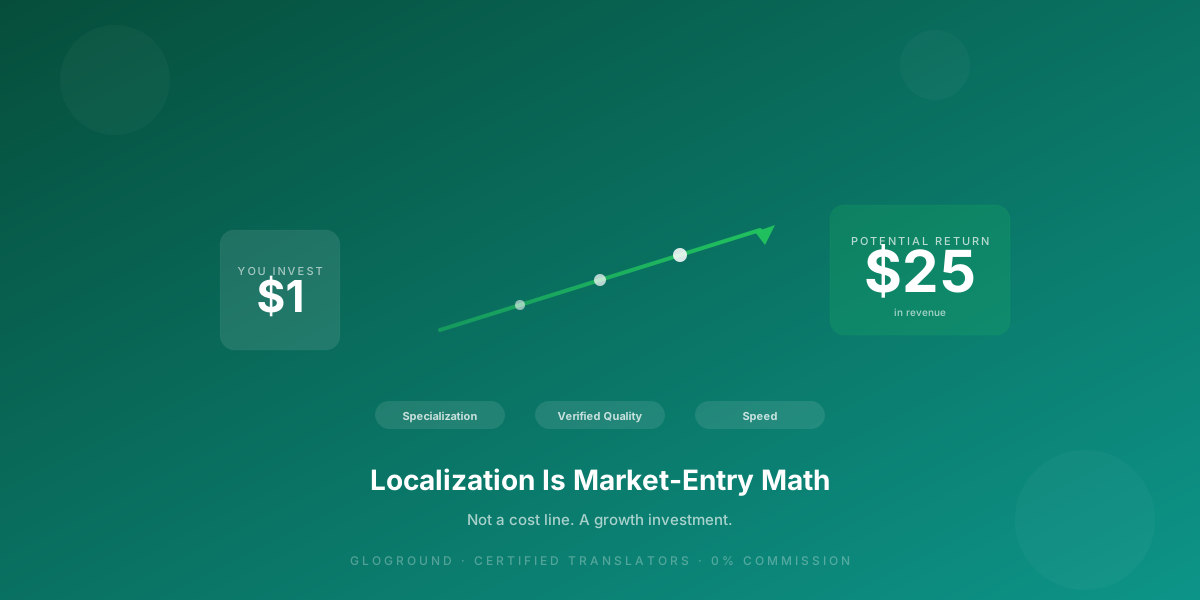
The ROI of localization can be substantial. Industry data points to up to $25 returned for every $1 invested, and Shopify has measured a 13% conversion lift when buyers see a store in their own language. The exact return depends on market, content type, and execution — but the direction is clear: localization behaves more like a growth investment than a cost.
Translated, one of the largest language service companies, recently published a finding that should have changed how every marketing leader thinks about localization budget: every $1 invested in localization can return up to $25 in revenue.
Even if you treat that number as directional rather than universal, the larger point still stands. Localization is rarely just a cost line. In the best cases, it behaves much more like a growth lever.
And yet many companies still budget for it like overhead.
That is the mismatch.
At the same time, global expansion is not slowing down. Shopify projects global ecommerce sales will reach $6.88 trillion in 2026, and more teams are pushing into new markets faster than their content operations are ready to support. Recent localization-industry reporting suggests companies plan to accelerate market expansion in 2026, while a meaningful share have already delayed or pulled back launches because localization was not strong enough to support them.
That gap is where ROI gets lost.
What Is the ROI of Localization?
The short answer: returns vary by market and product, but the upside can be significant.
The most cited figure comes from Translated, which reported that every $1 spent on localization can return up to $25 in revenue. Shopify has measured a 13% relative lift in conversion when buyers are shown a store in their own language rather than the default one.
Those numbers are directional, not guarantees. Real-world localization ROI depends on three things: how well the translator fits the content, how high the stakes of that content are, and how fast the localized assets reach the market.
It also depends on scale. Shopify projects global ecommerce sales will reach $6.88 trillion in 2026, which means the addressable upside of reaching buyers in their own language keeps growing. The question is no longer whether localization returns value. It is whether your version of it is strong enough to capture that value instead of leaking it.
That is what the rest of this article breaks down.
The Return Most Teams Still Underestimate
There is a simple reason localization produces strong returns when it works: it sits close to conversion.
Customers buy more easily when the site speaks their language, the product feels native to the market, and the buying experience does not ask them to mentally translate their way through checkout. Shopify has said its own data shows a 13% relative increase in conversion when buyers are shown a store in their own language rather than the store's default language. Other localization vendors cite even bigger upside in certain contexts, with some putting the ceiling far higher when language, market fit, and buying intent all align.
That is why this is not really a translation argument. It is a revenue argument.
A local-language landing page does not just sound nicer. It reduces hesitation. It improves clarity. It lowers trust friction. In some categories, that difference is enough to move a customer from "maybe later" to "buy now."
The market context makes that more important, not less. Global ecommerce is already huge, and still growing. If more companies are entering more markets, then the question is no longer whether localization matters. It is whether your version of it is strong enough to convert the traffic you are already paying to acquire.
Why Localization Spend So Often Misses Its Own ROI
The uncomfortable truth is that plenty of localization budgets do not fail because they are too small.
They fail because they are spent in ways that break the return before it has a chance to show up.
The most common mistake is obvious: buying for cost instead of fit. A team chooses the lowest-cost vendor, assumes translation is translation, and discovers too late that awkward copy, unclear wording, or weak terminology has quietly pulled conversion down instead of lifting it.
The second mistake is using general translation for specialized content. Marketing copy is not product documentation. Legal text is not app UI. A homepage for a new market should not be handled the same way as a compliance attachment. When the content and the translator are mismatched, the output may be technically acceptable and still commercially weak.
Then comes the third cost: rework.
The launch slips. Internal reviewers rewrite copy after the fact. Regional teams step in late. Marketing calendars move. Product teams wait. By then, the company has not just paid for translation. It has paid for delay.
This is how a strong theoretical ROI turns into a mediocre one. The investment was real. The execution path was wrong.
If you want the darker side of that equation, Your Company Is Losing Money on Translation. You Just Don't Know How Much Yet is the blunt version.
What Actually Drives Localization ROI
Most of the return comes down to three things.
1. Specialization
This is the one teams still underestimate.
Marketing content needs a marketing translator. Legal content needs a legal translator. Product onboarding, HR policy, ecommerce merchandising, investor communication — each one behaves differently once it crosses a language boundary.
The closer the translator is to the content's real function, the better the result tends to perform. That is not a stylistic preference. It is part of the revenue logic. Good localization works because it feels native to the buyer and appropriate to the context.
2. Verified Quality
Self-reported profiles are not enough when the content matters.
If your launch depends on the output, it helps to know the translator has actually been tested, not just listed themselves as "professional." Verified quality changes the risk profile of the project. It also reduces revision cycles, which protects the very thing ROI depends on: speed to market.
That is why certification matters more than many buyers think. It is not only about trust. It is about reducing the hidden drag between budget spent and market impact achieved.
3. Speed
This point gets lost because speed is often treated as a production concern.
It is not. It is part of the return.
A strong translation delivered too late can still miss the opportunity window. Market entry timing matters. Campaign timing matters. Product launch timing matters. If the right translator is buried under agency layers, procurement lag, or poor matching, the return starts shrinking before the asset is even live.
This is one reason direct matching matters so much. It shortens the path between need and execution.
The Math Looks Different When You Get the Inputs Right
When localization works, the gains tend to stack.
A better translator-to-content match improves market fit. Better market fit improves conversion. Better quality reduces rework. Less rework protects launch timing. Faster launch means the revenue window opens sooner. And when you remove unnecessary commission pressure from the middle of the workflow, the same budget can often reach stronger talent.
That is where the ROI curve starts to behave the way leadership hoped it would.
This is also where GloGround's structure matters. The platform is built around 20 specialization categories, a two-step certification process, and direct matching between clients and translators. That means companies are not sorting through generic profiles and hoping the fit is right. They can search for the right language pair, the right specialization, and verified credentials from the start.
And because GloGround runs on a 0% commission model for translators, the economics are cleaner. The budget is not quietly distorted by another percentage being stripped out after the rate is agreed. That makes it easier to hire stronger translators without inflating the total cost.
Localization Is Not a Cost Line
This is the mindset shift most teams still need to make.
The question is not "How cheaply can we translate this?"
The better question is: Which translator gives this market the best chance of converting?
That is a very different conversation.
Once you frame localization as growth infrastructure rather than content overhead, the logic changes fast. You stop optimizing only for cost containment. You start optimizing for market response, launch speed, and trust.
That is where ROI actually lives.
And if your team is entering a new market this year, that is probably the more important budgeting question to ask now — before the campaign, before the launch, before the rework, and before the missed quarter gets blamed on something else.
If you want the practical hiring angle, How to Hire a Qualified Translator is the right follow-up. And if your expansion touches regulated material, Legal Translation: Why Law Firms Pay Premium Rates for Specialized Translators is worth reading too.
What to Do Next
Localization does not need to be justified as a nice-to-have anymore.
The numbers are already strong enough to make the case. The real question is whether the way you buy translation is helping that return show up — or quietly preventing it.
Because once you see localization clearly, it stops looking like a line item.
It starts looking like market-entry math.
Search for certified translators on GloGround: Find a Translator
Frequently Asked Questions
What is the ROI of localization?▼
Returns vary by market and product, but the upside can be significant. Translated has reported that every $1 spent on localization can return up to $25 in revenue, and Shopify has measured a 13% conversion lift when buyers see a store in their own language. Real-world ROI depends on translator fit, content type, and how fast localized assets reach the market.
Why does localization quality affect ROI so much?▼
Buyers hesitate when copy feels translated rather than written for them. Weak localization lowers conversion, increases support load, and often forces rework that delays launch. Quality work removes that friction, which is where most of the revenue gain actually comes from.
How fast can I source a translator for a new market launch?▼
On GloGround, you can filter by language pair, specialization, and certification, then invite a translator directly. Because there is no agency layer in the middle, qualified specialists can typically start within days rather than weeks.
Does specialization really change localization ROI?▼
Yes, and it is usually the single biggest lever. Marketing copy needs a marketing translator. Legal text needs a legal translator. Product UI needs someone who has localized product UI before. Mismatched expertise is the most common reason localization spend underperforms.
Related Posts
5x More Content, Same Budget: The Localization Squeeze of 2026
Enterprise teams are being asked to scale localized content without scaling budgets. AI helps, but high-risk content still needs verified human specialists.
70% of Freelance Translators Lost Work Last Year. The Other 30% Chose a Different Path.
The translation market is still growing, but many freelance translators are seeing less work. Here is why generalist demand is shrinking, why specialized translators still earn a premium, and how certification can help you stand out.
Your Company Is Losing Money on Translation. You Just Don't Know How Much Yet.
The real cost of translation goes far beyond the invoice. Rework, delays, lost customers, and compliance risks add up fast. Here is how to avoid the most expensive mistakes.