50% of Translators Just Stopped Offering MTPE Discounts. Here's What They're Doing Instead.
TL;DR: 85.99% of freelance translators report MTPE rates have worsened, and 50% have stopped accepting the discount. The translators who refused MTPE diversified into specialized translation, certification-based positioning, and direct-match platforms. Here is how the exit strategy works.
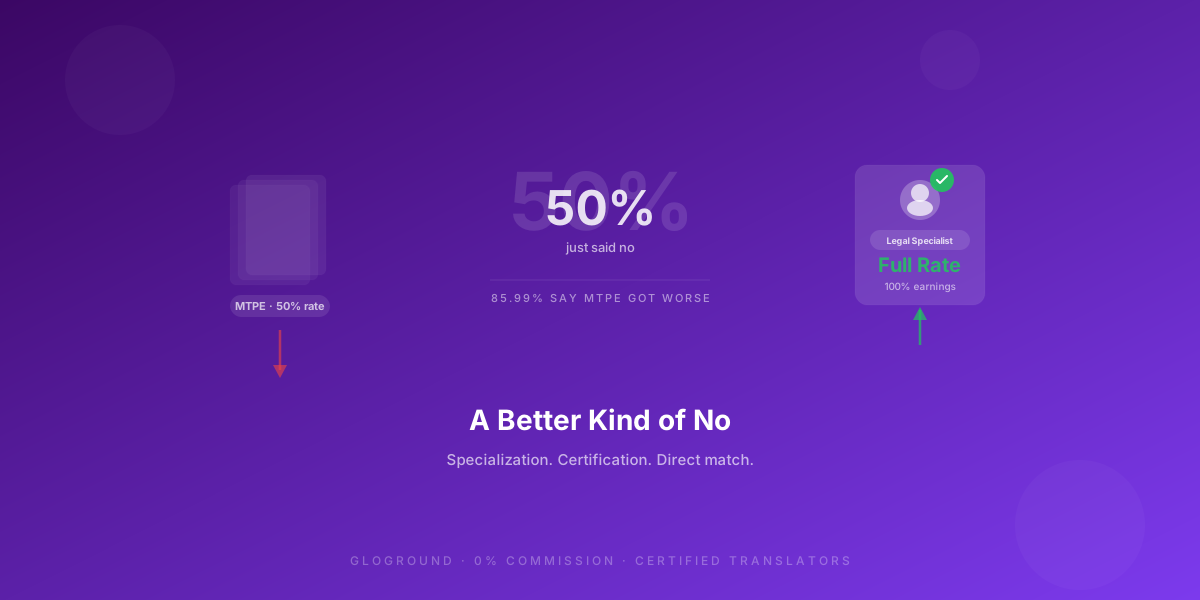
50% of Translators Just Stopped Offering MTPE Discounts. Here's What They're Doing Instead.
According to a 2025 industry survey, 85.99% of freelance translators say MTPE pricing has gotten worse, not better. About half responded the same way: they stopped accepting the discount.
That is the part worth paying attention to.
For years, MTPE was sold as a reasonable compromise. The machine would do the first pass. The human would clean it up. The rate would be lower, but the effort would be lower too. In theory, everyone won.
In practice, many translators have stopped believing that math.
The MTPE Math Never Really Added Up
Research has long suggested that machine translation post-editing can take 70% to 85% of the effort of full translation, depending on the text and the quality of the raw output. The market often pays nowhere near that proportion. In many cases, MTPE rates land closer to 50% to 60% of full translation rates.
That gap is the whole story.
A machine may generate a first draft, but the translator still carries the real responsibility: terminology, tone, ambiguity, consistency, legal or technical nuance, and final accountability. And as machine output gets smoother on the surface, the job often becomes more mentally demanding, not less. Bad output is easy to fix. Plausible output is harder. It forces you to slow down, doubt more, and verify more.
That is not cheap labor. It is simply harder to price clearly.
Why So Many Translators Are Walking Away
What is striking is that refusing MTPE discounts has not always meant less work. In many cases, it has meant different work.
Once a translator stops accepting discounted post-editing, they stop signaling that they are available for low-margin cleanup. The market reads that. So do clients.
That does not mean volume magically improves overnight. But it does change positioning. A translator who says no to MTPE discounts is often understood differently from one who routinely accepts them. The first begins to look like someone selling expertise. The second risks being treated as flexible processing capacity.
That distinction matters more than most platforms admit.
The Exit Routes People Are Actually Choosing
Most translators who step away from MTPE discounts do not replace that income with one dramatic move. They make several smaller, smarter shifts.
One is specialization. Legal, Medical, Financial, Gaming, and other high-context fields are harder to treat as generic post-editing work. That creates room for human judgment to matter again. If that is the direction you are considering, From Bilingual to Professional is still one of the clearest starting points.
Another is certification. This is not about prestige. It is about leverage. When a client asks why you no longer accept discounted MTPE, "because I am a certified specialist in this language pair" is a much stronger answer than "because the rates are too low."
A third is moving toward direct client matching. Much of the MTPE price pressure is amplified inside agency pipelines, where margin is taken before the work even reaches the translator. By the time the linguist sees the project, it is already framed as discounted work.
And finally, some translators are moving toward premium niches where buyers care more about accuracy, risk, and accountability than per-word savings.
That is not an emotional reaction. It is a market decision.
Why Certification Changes the Conversation
Certification matters because it turns a rate boundary into a professional position.
On GloGround, translators complete a Native Language Test and a Translation Pair Test before earning certification. That creates a visible signal that sits outside self-description.
This becomes especially useful when you need to explain why your work is priced differently. A translator who can point to verified certification and a clear specialization is no longer arguing from preference alone. They are showing clients a reason to place them outside the generic MTPE pool.
That is the real leverage. Not status. Credibility.
Why Direct Match Changes the Economics
The MTPE problem is not only about the rate on paper. It is also about how many hands touch the money before it reaches the translator.
Agency-heavy models are often where the strongest compression happens. The client may be paying a perfectly reasonable amount. But by the time margin is removed and the work is labeled "post-editing," the translator ends up carrying near-full responsibility for a discounted fee.
A direct-match model changes that equation.
On GloGround, client and translator connect without an agency markup, and the platform runs on 0% commission. That means the translator keeps the full client payment rather than agreeing on one rate and losing part of it again afterward. If you want the broader economics behind that, Why 0% Commission Changes Everything for Freelance Translators is the clearest companion piece.
What This Means for the Next Decision You Make
None of this means every translator should reject every MTPE project tomorrow.
It means MTPE is no longer the only realistic path, and more translators are beginning to act like they know that.
Some will stay in the post-editing pipeline and try to make volume work. Others will use specialization, certification, and direct matching to move into better-positioned work. The second path is usually slower at first. But it also tends to be more durable.
That is the larger shift here. About half of translators refusing MTPE discounts is not just a complaint trend. It is a signal that the market is starting to split.
And if you have already felt the strain of doing near-full translation work under half-rate logic, you probably do not need that explained to you.
You are not looking for a slogan. You are looking for a better structure.
If you have been watching specialization reshape who stays visible and who fades into the middle of the market, 70% of Freelance Translators Lost Work Last Year. The Other 30% Chose a Different Path. is the next piece to read.
A Better Kind of No
Saying no to MTPE discounts is not necessarily a rejection of technology.
Often, it is simply a refusal to let expert work be priced like low-risk cleanup.
That is the shift more translators seem to be making now.
And once that becomes clear, the next question is not only what you want to stop doing. It is what you want clients to find you for instead.
Create your translator profile on GloGround: create your account today
Frequently Asked Questions
Why are translators refusing MTPE discounts?▼
Academic studies show MTPE typically requires 70 to 85% of full translation effort, while market rates pay only 50 to 60%. As that gap widened, about half of freelance translators began refusing the discount. Many shifted to specialized non-MTPE work instead.
Will refusing MTPE reduce my work volume?▼
Short term, possibly. Longer term, many translators report diversifying into non-MTPE projects after positioning themselves clearly. Clients increasingly distinguish between general MTPE workers and specialized full-rate translators.
How does certification help me reject MTPE?▼
Certification provides a verifiable basis for rate negotiation. On GloGround, passing the Native Language Test and Translation Pair Test earns a verified badge that signals professional positioning beyond generalist post-editing work.
How does GloGround's 0% commission affect MTPE economics?▼
Agencies often drive the MTPE rate compression through margin capture. Direct-match platforms with 0% commission, like GloGround, route the full client payment to the translator, which can change the effective rate significantly even for the same project.
Related Posts
You're a Great Translator. So Why Can't Clients Find You?
Skilled translators often struggle with visibility on generic freelance platforms. Learn why discoverability is a structural problem and how expertise-based matching changes the game.
70% of Freelance Translators Lost Work Last Year. The Other 30% Chose a Different Path.
The translation market is still growing, but many freelance translators are seeing less work. Here is why generalist demand is shrinking, why specialized translators still earn a premium, and how certification can help you stand out.
Why Translation Quotes Vary So Much for the Same Project
Two quotes for the same translation project can look confusingly far apart. Here is what clients are actually paying for — and how to choose based on fit, not guesswork.