95 Days. €15 Million. The EU AI Act Compliance Risk Hiding in Your Translated Docs.
TL;DR: The EU AI Act becomes enforceable on August 2, 2026, with penalties up to €15 million. AI-translated compliance documents may fail the Act's transparency and audit requirements. Businesses have 95 days to source certified translators for regulated content.
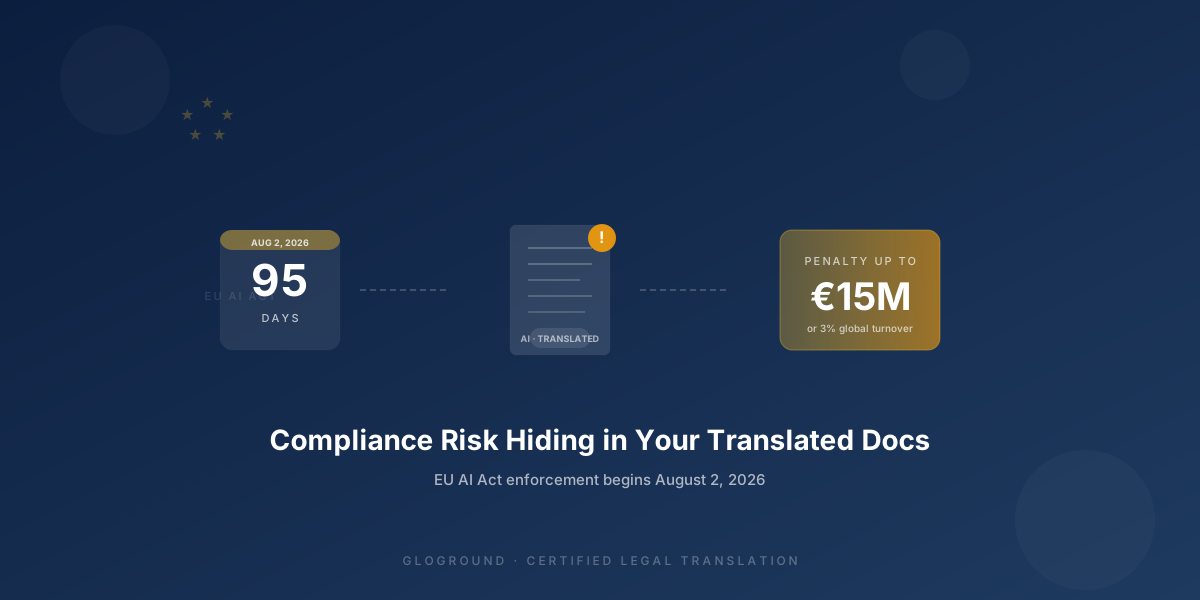
95 Days. €15 Million. The EU AI Act Compliance Risk Hiding in Your Translated Docs.
Ninety-five days from now, the second wave of EU AI Act obligations becomes enforceable. The penalty for getting it wrong is up to €15 million or 3% of global turnover, whichever is higher. And many companies still do not see how AI-translated compliance documents fit into that risk.
That blind spot is becoming expensive.
The Act does not ban AI-translated documents. But it does create a far stricter environment around documentation, transparency, oversight, and accountability. If your business operates in the EU, or sells into the EU, the documents around your AI systems now matter in a different way. Policies, notices, HR materials, customer disclosures, internal governance documents, and regulatory filings are no longer just support content. They are part of the compliance picture.
And that is exactly where many teams are exposed.
The August 2 Deadline More Teams Should Be Taking Seriously
The legal timeline is no longer theoretical. The AI Act entered into force in 2024. Some provisions have already started applying. The next major milestone is August 2, 2026, when much broader obligations become enforceable.
For many companies, the operational mistake is assuming this only concerns the model, product, or system itself. In reality, the surrounding documentation matters too. If a company cannot stand behind how a multilingual policy, disclosure, employee notice, or compliance document was translated, that weakness does not sit outside the risk chain. It sits inside it.
That is why this deadline is not just technical. It is procedural.
Where AI-Translated Compliance Documents Break Down
The problem with AI translation in regulated content is rarely obvious nonsense. It is usually something quieter.
A legal term is softened. A requirement is translated inconsistently across documents. A sentence is grammatically clean but slightly wrong in regulatory meaning. A policy reads well enough for circulation, but no one can later explain why a key phrase was rendered that way, who reviewed it, or whether the translator had any subject-matter qualification at all.
That is the issue.
Compliance language does not just need to sound fluent. It needs to be traceable, reviewable, and defensible. That is where AI output often fails. It may be fast. It may even be readable. But readability is not the standard auditors care about.
What matters is whether the company can show a reliable process behind the final text. That broader pattern — where AI translation looks acceptable until it is examined more closely — is something we covered in 78% of Enterprises Avoid AI for Legal Content. Here's Why.
Why "Verified Translation" Starts to Matter Here
In most businesses, translation has long been treated as an execution task. In regulated environments, that assumption starts to break.
If the document is tied to legal obligations, HR governance, user transparency, or risk controls, the translation process itself becomes relevant. Someone may eventually ask who produced it, what qualified them to do it, and what review happened before the document was approved.
A generic freelancer profile does not answer those questions well.
That is why certification matters more in this context than it does in ordinary marketing content. A verified process creates a much clearer audit trail than a self-reported platform profile ever can. On GloGround, translators move through a Native Language Test and a Translation Pair Test before earning certification status. That does not replace internal legal review, but it does create a stronger starting point: you are not guessing whether the person handling your regulated content has met a tested baseline.
And in a compliance environment, that difference is not cosmetic. It is procedural.
If this sounds familiar, You Hired a Translator You Couldn't Verify. Here's Why That Keeps Happening explains why this trust gap shows up so often in the first place.
The 95-Day Action Plan
The practical response is not complicated. But it does need to start now.
First, identify any AI-translated documents produced in the last six months that connect to legal, HR, compliance, or regulatory workflows.
Second, separate low-risk content from regulated content. A blog post and a compliance notice should not be reviewed under the same standard.
Third, match sensitive content with certified legal translators. Speed matters, but fit matters more. This is not the moment to source the cheapest available bilingual profile and hope for the best.
Fourth, add review and documentation. The real question is not just whether the text has been translated, but whether the company can explain how that version was produced and checked.
Finally, finish early enough that August does not become a procurement emergency.
For businesses working under deadline, GloGround helps shorten that path by allowing direct matching through language pair, certification status, and specialization filters, including Legal.
And if your team is still treating legal translation like a normal content workflow, Legal Translation: Why Law Firms Pay Premium Rates for Specialized Translators is a useful place to recalibrate.
Why This Cannot Wait
Ninety-five days is not a crisis. But it is not much slack either.
That is what makes this moment risky. The work is still manageable now. It becomes much harder once legal, compliance, product, and regional teams are all trying to fix multilingual documentation at the same time.
The deeper issue is simple: many businesses still think translation risk begins when a sentence is visibly wrong. In regulated environments, it begins much earlier — when nobody can prove how the sentence was produced.
That is why this is not only a language decision. It is a governance decision.
What to Do Next
The right response is not to remove AI from every multilingual workflow overnight.
It is to stop using unverified translation as if regulated content were ordinary copy.
Start with the documents that matter most. Put qualified humans back into the chain where traceability and judgment matter. Build the review path now, while there is still time to do it properly.
Because once August arrives, the question will not be whether your translated compliance documents sounded acceptable at the time.
It will be whether they can be defended.
Search for certified translators on GloGround: Find a Translator
Frequently Asked Questions
Does the EU AI Act apply to AI-translated documents?▼
The Act regulates AI systems, but all documents tied to high-risk systems — including regulatory filings, compliance materials, and HR policies — must meet accuracy and traceability requirements. AI-translated documents used without human verification may fall short of the documentation obligations.
What is the penalty for non-compliance?▼
Violations can result in fines of up to €15 million or 3% of global annual turnover, whichever is higher. Most obligations become enforceable starting August 2, 2026.
Why can't AI translation tools satisfy the audit requirements?▼
AI translation typically cannot provide source attribution, decision documentation, or verifiable credentials. The EU AI Act requires an auditable trail showing who performed the work and at what professional level.
How can I find a certified translator quickly?▼
On GloGround, you can filter translators by language pair, specialization such as Legal or Compliance, and verified certification status. Direct matching lets you connect with the right professional without agency markup, often within days.
Related Posts
78% of Enterprises Avoid AI for Legal Content. Here's Why
Most enterprises already avoid AI translation for legal and contractual content. Here is what the data says about translation risk and why certified human translators still matter in regulated industries.
Why Translation Quotes Vary So Much for the Same Project
Two quotes for the same translation project can look confusingly far apart. Here is what clients are actually paying for — and how to choose based on fit, not guesswork.
81% of Agency Translators Are Pressured to Cut Rates. Guess Whose Project Pays the Price.
When agencies pressure translators on rates, the cost does not disappear — it shows up as quality risk on your project. Here is what the data says about agency rate compression and what direct hiring actually changes.