You Hired a Translator You Couldn't Verify. Here's Why That Keeps Happening.
TL;DR: Generic freelance platforms let translators claim any skill without verification. GloGround's two-tier certification, 20 specialization categories, and verified profile metrics give clients real proof before they hire.
You Hired a Translator You Couldn't Verify. Here's Why That Keeps Happening.
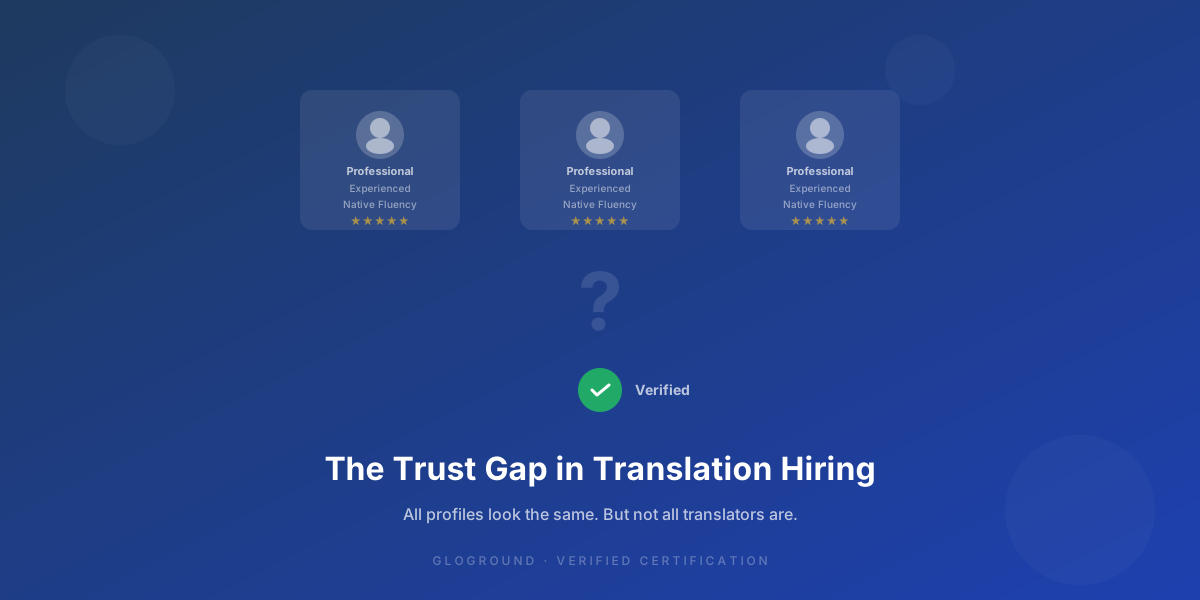
You found three translators online. Their profiles all said "professional," "experienced," and "native-level fluency." You picked one — and you still have no idea if that was the right call.
That uncertainty is more common than most clients expect.
Hiring a translator often feels harder than it should because many profiles look convincing in the same way. The language sounds polished. The claims sound credible. The ratings look reassuring. But once the project begins, clients often realize they were still making an educated guess.
That is not because clients are careless. It is because translation hiring is built around a real trust problem.
Unlike design, where you can review a portfolio visually, or development, where you can test code or assess technical output more directly, translation is much harder to verify before the work is done. Unless you already know the target language well, you may not be able to judge quality confidently in advance. That creates a gap between what a profile promises and what a translator can actually deliver.
That gap is where bad hiring decisions often happen.
The Trust Gap in Translation Hiring
Translation is one of those services where the buyer often cannot fully evaluate quality before purchase.
A project manager, marketer, founder, or operations lead may know they need a strong translator, but they may not know how to distinguish one profile from another with confidence. When most platforms rely on self-reported skills and star ratings, the hiring process becomes less about verified ability and more about surface signals.
That is the heart of the trust gap.
On many general freelance platforms, a translator can list almost any language, specialization, or experience level with little or no proof attached. A profile may say "legal translation," "medical expertise," or "native fluency," but the client often has no reliable way to confirm whether those claims have been independently validated.
Ratings help, but only to a point.
A profile with 5 stars and 200 reviews may look trustworthy, yet that still does not guarantee domain-specific expertise. A translator may be excellent at e-commerce product descriptions and still not be qualified for a legal contract, a medical report, or financial disclosure material. Volume of reviews is not the same as relevant qualification.
This is why translation hiring can feel uniquely risky. Clients are often choosing between profiles that sound equally confident, without enough evidence to know which one actually fits the work.
What "Qualified" Actually Looks Like
When clients say they want a qualified translator, they usually mean more than fluency.
They want someone who can handle the language pair accurately, write naturally in the target language, understand the subject matter, and work reliably in a professional setting. In other words, they want proof of readiness, not just a strong self-description.
That is why verified certification matters.
At GloGround, qualification is built around a two-step translator certification process.
The first stage is the Native Language Test, which measures command of a translator's native language through timed assessment. The second stage is the Translation Pair Test, which evaluates how well the translator works between source and target languages in real translation tasks.
Together, these stages help create a more meaningful professional signal before the first client ever hires them.
Qualification also includes subject-matter clarity. GloGround supports 20 specialization categories, including Legal, Medical, Financial, IT, Gaming, and more. Translators can also show more detailed domain focus through field-specific keywords. For example, someone in Legal may indicate focus areas like Contract Law, Patents, or IP. That matters because the difference between "I can translate" and "I can translate this kind of document well" is often where project quality is decided.
Profiles That Show Proof, Not Promises
One of the biggest differences between a generic listing and a verified profile is the kind of information a client can actually rely on.
A self-reported profile usually tells you what the translator says about themselves. A verified profile shows what has been demonstrated.
On GloGround, profiles are designed to make that difference visible.
Clients can review completed project counts, average rating on a 1-to-5 scale, total number of reviews, certification badges, and specialization badges. They can also read client comments that describe actual working experiences rather than marketing language written by the translator themselves.
This changes the hiring experience in an important way.
Instead of asking, "Does this person sound professional?" the client can ask, "What has this person already proven?" That is a much stronger starting point.
It also makes the profile more useful for comparison. Two translators may both claim to handle financial translation, but if one has verified certification, a visible finance specialization, completed projects, and strong client reviews mentioning accuracy and responsiveness, the decision becomes much less guess-based.
That kind of visibility reduces hiring stress on both sides.
Finding the Right Translator Without Guessing
Clients usually do not want more profiles. They want a clearer way to narrow them down.
That is where search structure matters.
GloGround gives clients ways to filter by the signals that matter most in translation hiring: language pair, specialization, rating, experience level, and certification status. That helps reduce the number of irrelevant matches and brings stronger-fit candidates to the surface faster.
For clients with a specific project in mind, the platform also supports Job Invitation, allowing them to invite a particular translator directly rather than waiting for open responses. This is especially useful when a client already knows the profile they want or wants to move faster with a targeted hire.
Search ranking also matters. On GloGround, results are shaped by rating and completed projects, helping clients see stronger-performing professionals first. Professional subscription translators may also receive higher visibility in search, which adds another layer of incentive for profile seriousness and active marketplace participation.
The result is a process that feels less like browsing promises and more like filtering verified options.
Why This Matters More Than It Seems
The trust gap in translation hiring is not just a user-experience problem. It has downstream cost.
When clients hire a translator they cannot really verify, the risk does not end at uncertainty. It often shows up later as revision cycles, launch delays, poor customer response, or content that needs to be redone. In higher-stakes fields, it can also create legal, compliance, or reputational risk.
We explored that more directly in Your Company Is Losing Money on Translation. You Just Don't Know How Much Yet.
The point is simple: uncertainty at the hiring stage rarely stays contained there. It spreads into the project.
When clients can trust the hiring signals from the beginning, the whole working relationship changes. Briefs become clearer. Communication becomes smoother. Review cycles get shorter. And confidence improves before the first file is even delivered.
That is why verified matching matters more than it may seem at first glance.
For a step-by-step framework on evaluating translators, our guide on How to Hire a Qualified Translator covers what to look for in more detail. And if you are new to the platform, Welcome to GloGround offers a broader overview of how it works.
Trust Should Not Require Guesswork
Clients should not have to rely on intuition when hiring for something as important as translation quality.
The problem is not that clients are failing to screen hard enough. The problem is that many platforms were not built to provide real proof in the first place. When every translator can claim every skill, trust becomes a branding exercise instead of a qualification process.
A better system makes credentials visible — through verified certification, specialization-based matching, transparent profile metrics, and reviews that reflect real collaboration. That is what turns hiring from a risk into a decision.
Search for certified translators on GloGround: Find a Translator
Frequently Asked Questions
How do I know if a translator is actually qualified?▼
On GloGround, translators earn certification by passing two tests — a Native Language Test and a Translation Pair Test. Only those who pass receive a verified badge. Combined with 20 specialization categories, you can confirm both language ability and domain expertise before hiring.
Can I see a translator's track record before hiring them?▼
Yes. Every GloGround profile shows completed projects, average rating on a 1-to-5 scale, total reviews, and individual client comments. This gives you real performance data, not just self-reported claims.
How does GloGround match me with the right translator?▼
You can filter by language pair, specialization, rating, and experience level. You can also send direct project invitations to specific translators. The platform's matching algorithm ranks results by rating and completed projects.
What if I need a translator for a very specific field?▼
GloGround offers 20 specialization categories including Legal, Medical, Financial, IT, and Gaming. Translators can select up to three specializations and add domain keywords like Contract Law or Clinical Trials for precise matching.
Related Posts
81% of Agency Translators Are Pressured to Cut Rates. Guess Whose Project Pays the Price.
When agencies pressure translators on rates, the cost does not disappear — it shows up as quality risk on your project. Here is what the data says about agency rate compression and what direct hiring actually changes.
78% of Enterprises Avoid AI for Legal Content. Here's Why
Most enterprises already avoid AI translation for legal and contractual content. Here is what the data says about translation risk and why certified human translators still matter in regulated industries.
How to Hire a Qualified Translator: A Client's Complete Guide
Learn how to find, evaluate, and hire the right translator for your project. A practical guide covering qualifications, red flags, and tips for successful translation partnerships.