You're a Great Translator. So Why Can't Clients Find You?
TL;DR: Generic platforms bury skilled translators in price-based competition. GloGround's certification badges, specialization matching, and quality-based algorithm help the right clients find you — without racing to the bottom on rates.
You're a Great Translator. So Why Can't Clients Find You?
You have the certifications, the experience, and the language skills. You have done the work. But somehow, the clients who need exactly what you offer keep hiring someone else — or worse, they never even see your profile.
If that feels familiar, you are not imagining it.
A lot of strong translators are not struggling because they lack skill. They are struggling because they are trying to be found inside systems that were not built to surface expertise well. Their profiles sit next to thousands of others. Their specialization gets flattened into a few generic skill tags. Their rates become more visible than their judgment, subject knowledge, or professional track record.
And over time, that creates a specific kind of frustration.
You know you can deliver high-quality work. You know you are a better fit for certain projects than many of the profiles clients see first. But the platform does not make that difference easy to detect. So instead of competing on expertise, you end up competing on visibility tricks, response speed, or price.
That is not just discouraging. It is structural.
The Discoverability Problem in Translation
Many freelance platforms were built to serve broad categories of work.
That creates convenience for the platform, but not always clarity for the client or fairness for the specialist. In translation, this becomes especially difficult because good work is highly contextual. A translator who is excellent in legal contracts is not automatically the right fit for gaming localization. A translator who handles marketing copy beautifully may not be ideal for clinical trial documentation.
Yet on many generic platforms, those distinctions are hard to see.
The filters are often too broad. Skill labels are self-reported. Search results may prioritize lowest price, most recent activity, fastest response, or general marketplace momentum rather than true subject fit. A translator can write "professional," "expert," or "native fluency" in a profile, but if there is no real verification attached, those claims do not help clients compare candidates with confidence.
When everyone can claim everything, expertise becomes invisible. That is the core of the translator discoverability problem.
Clients are often not choosing the best translator for the work. They are choosing from the small set of translators the platform happened to show them first. And if the system rewards price over precision, then translators are pushed toward being cheaper rather than more clearly specialized.
That creates a poor outcome on both sides.
Competing on Expertise, Not Price
The real solution to discoverability is not "write a better bio" in isolation.
It is to work inside a system where expertise is structured, visible, and searchable.
That is the shift GloGround is designed to make.
Instead of asking translators to differentiate themselves through generic claims alone, GloGround gives them ways to show proof. Certification badges create visible signals of professional readiness. Specialization categories help structure subject expertise. Domain keywords allow translators to describe the specific areas within a field where they work best.
This changes what clients can actually search for.
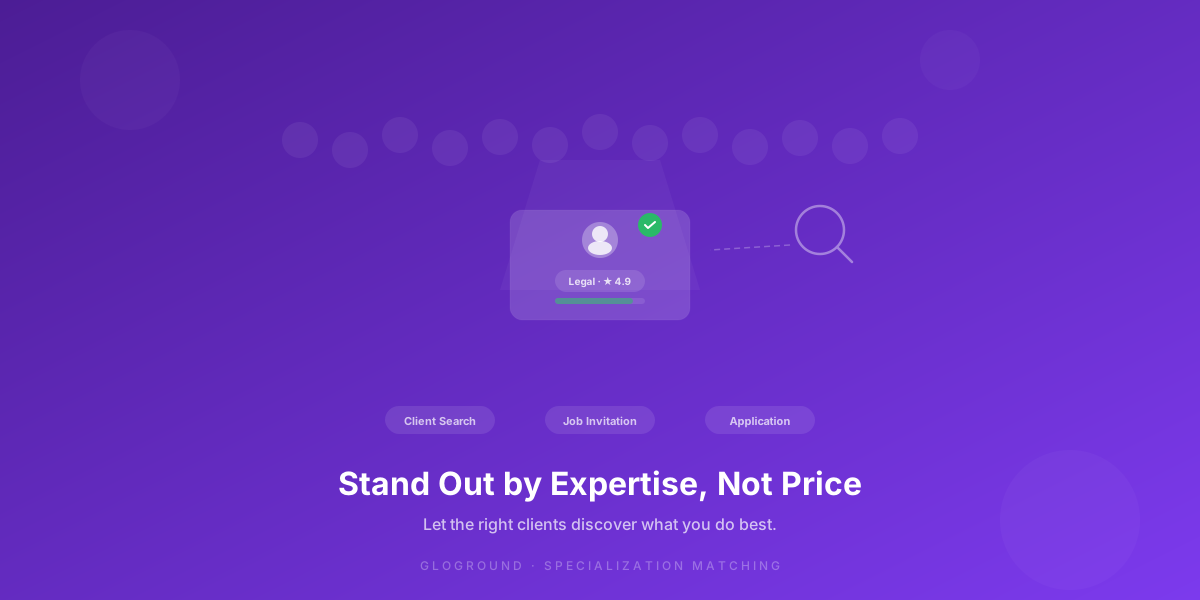
Instead of browsing an endless list of generalists, a client can look for a translator with the right language pair, the right specialization, and the right performance history. That means a legal translator can be discovered as a legal translator, not as one profile in a broad sea of "translation services."
You are no longer trying to win work by becoming the cheapest acceptable option. You are trying to become the clearest fit for the right project. That is a much healthier way to build a professional career — something we explored in From Bilingual to Professional.
How Clients Actually Find Translators on GloGround
Clients on GloGround do not simply scroll through a random list of translators.
The platform's translation client matching process begins with relevance. Search results first align around language pair and specialization, which means the system is trying to surface fit before anything else.
After that, ranking takes performance into account. Results are ordered using quality signals such as rating and completed projects, helping stronger track records become more visible over time. Professional subscribers may also receive higher placement in search results, which rewards active investment in visibility without turning every project into a race to the bottom on pricing.
There are three main discovery routes on GloGround:
- Client Search — Clients search for translators using language pair, specialization, and other profile signals.
- Job Invitation — Clients can directly invite a translator they want to work with.
- Job Application — Translators can apply for relevant projects and show fit proactively.
That combination matters because not every translator grows the same way. Some are discovered through search. Some are invited directly once they build profile strength. Some win early momentum through strong applications. What matters is that the system gives expertise multiple ways to become visible.
Building a Profile That Works for You
Discoverability is structural, but profile quality still matters. The difference is that on GloGround, your profile works inside a system designed to make professional information useful.
Your bio can include up to 2,000 characters, giving you room to explain what you do clearly instead of compressing your expertise into generic phrases. You can add education, professional experience, portfolio URL, and LinkedIn URL to give clients a fuller picture of your background.
Specialization keywords also play an important role. They are not just descriptive. They help clients find you when they search for specific kinds of expertise. A Legal profile might include terms like Contract Law, Patents, or Intellectual Property. A Medical profile might include Clinical Trials or Regulatory Documents. This turns your profile into something closer to searchable professional positioning, not just a static résumé.
And then there is the compounding effect. Once you begin completing projects and collecting reviews, your visibility improves further. Completed project count, rating, and client feedback all become stronger signals over time. Discoverability is not only about getting seen once. It is about building a professional presence that becomes easier to find and trust with each good project.
If you are ready to get started, Your First 48 Hours on GloGround walks through the full onboarding process.
Visibility Without Giving Up Your Earnings
One of the most frustrating aspects of many platforms is that even when translators do manage to become visible, they often lose a significant share of what they earn through commission.
GloGround is structured differently. With 0% commission, translators keep 100% of their project earnings. If you choose a Professional subscription, that is better understood as an investment in visibility rather than a percentage-based penalty on income.
Strong translators should not have to choose between being found and being paid fairly. For a deeper look at how that model works, Why 0% Commission Changes Everything for Freelance Translators breaks it down in more detail.
Great Translators Should Not Be Hard to Find
A healthy translation marketplace should not bury specialists under noise.
It should help clients find the right people faster, and it should help good translators become visible for the reasons that actually matter: language pair fit, specialization, verified ability, and strong professional performance.
Once you understand that discoverability is partly structural, you stop treating invisibility as proof that your work lacks value. Instead, you start asking a more useful question: am I trying to be found in a place that actually rewards what I do well?
For many translators, that question changes everything.
Create your translator profile on GloGround: create your account today
Frequently Asked Questions
Why can't clients find me on other platforms?▼
Most freelance platforms lack specialization filters and sort results by price or recent activity. Without verified credentials, skilled translators get buried alongside everyone else regardless of expertise.
How does GloGround's matching algorithm work?▼
When clients search, GloGround matches by language pair and specialization, then ranks results by rating and completed projects. Professional subscribers receive higher placement in search results.
How many specializations can I add to my profile?▼
You can select up to three specialization categories and add domain-specific keywords for each. For example, a Legal specialization might include keywords like Contract Law, Patents, or Intellectual Property.
Do I need to pay to be visible on GloGround?▼
No. During Early Access, certification is free and all translators appear in search results. GloGround charges 0% commission on project earnings. A Professional subscription boosts your search ranking but is not required to be found.
Related Posts
50% of Translators Just Stopped Offering MTPE Discounts. Here's What They're Doing Instead.
85.99% of freelance translators say MTPE pricing has worsened, and about half are now refusing the discount. The translators who walked away are not losing work — they are choosing a different career path. Here is the strategy.
70% of Freelance Translators Lost Work Last Year. The Other 30% Chose a Different Path.
The translation market is still growing, but many freelance translators are seeing less work. Here is why generalist demand is shrinking, why specialized translators still earn a premium, and how certification can help you stand out.
Legal Translation: Why Law Firms Pay Premium Rates for Specialized Translators
Discover why legal translation commands premium rates, what skills are required, and how specialized translators can build a lucrative career serving law firms and legal departments.