70% of Freelance Translators Lost Work Last Year. The Other 30% Chose a Different Path.
TL;DR: A large share of freelance translators reported less work last year, even as the language services market continues to grow. The difference is where that growth is happening: specialized, verified translation is becoming more valuable while generalist work is under pressure.
70% of Freelance Translators Lost Work Last Year. The Other 30% Chose a Different Path.
If you are a freelance translator and the past year has felt harder than it should have, you are not imagining it.
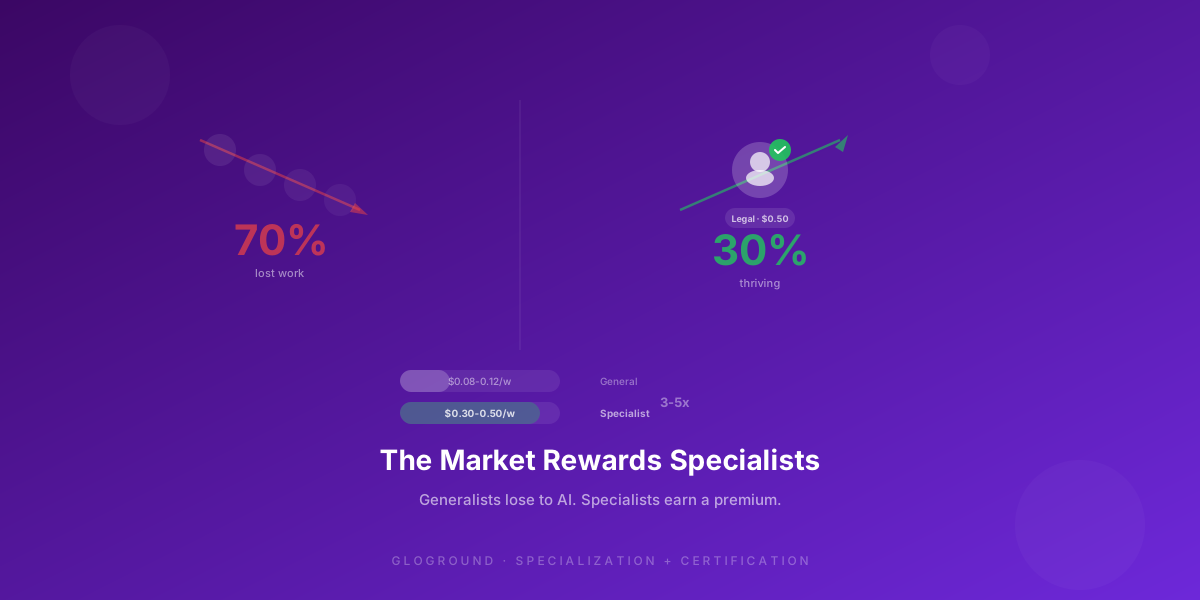
A recent survey by the Chartered Institute of Linguists found that seven out of ten freelance translators reported a drop in work volume over the previous year. At first glance, that sounds like the market is collapsing.
But the bigger picture tells a different story.
The translation industry itself is still growing. Forecasts point to a global market expanding from around $65.5 billion in 2026 to $147.5 billion by 2034. So if the market is getting larger while many freelancers are getting less work, the problem is not that demand has disappeared. It is that demand is shifting.
That shift is creating a more divided market.
Lower-risk, repetitive, and generalist translation work is increasingly being handled by AI and machine translation tools. At the same time, specialized translation, regulated content, creative localization, and review-heavy work are becoming more valuable. Some translators are finding it harder to stay booked. Others are building stronger rates and more stable demand.
The gap between those two experiences is no longer random. It is becoming structural.
That is the reality more freelancers are now dealing with: not a shrinking profession, but a market that rewards clear expertise more than ever before.
The Market Is Growing. Your Share Might Not Be.
This is one of the most frustrating parts of working in translation right now.
You can look at market reports and see growth almost everywhere. Language services are expanding. Multilingual content is increasing. Global products need localization. New digital channels are creating more text, more updates, and more cross-border communication than ever before.
And yet many individual translators still feel their pipelines getting thinner.
Both things can be true at the same time.
Growth in the market does not automatically mean growth for every type of translator. A large share of that growth is concentrating in areas where clients need more than bilingual ability. They need subject knowledge, stronger quality control, cultural judgment, and confidence that the final work can hold up in a business, legal, medical, or technical setting.
That is why some categories are under pressure while others are becoming more valuable.
General business documents, repetitive website copy, simple product text, and high-volume low-context content are now much easier to automate than they were even a few years ago. For clients, the temptation is obvious: faster turnaround, lower cost, and acceptable output for low-risk use cases.
But the same logic does not apply everywhere.
Legal translation, medical materials, financial documentation, technical content, and culturally sensitive marketing still require human judgment in ways automation cannot consistently replace. Game localization is another good example. It is not only a growing market; it is also one where tone, user experience, character voice, and cultural fit matter deeply.
In other words, the market is not rewarding "translation" in the abstract. It is rewarding the parts of translation that still carry nuance, liability, or context.
That is why the market can grow while your inbox gets quieter. The opportunity is still there. It is just moving toward translators who can show where they fit in that new landscape.
The $0.50 vs. $0.08 Gap
One of the clearest signs of this shift is the growing gap in rates.
General translation work may still sit around $0.08 to $0.12 per word in many contexts. Specialized work can reach $0.30 to $0.50 per word depending on the field, the language pair, and the level of expertise involved.
That is not a small difference. It is often a three-to-five-times premium.
And it is not just about pricing strategy.
That gap exists because clients are not buying the same thing.
A generalist assignment may require solid language ability and efficiency. A legal, medical, or financial project asks for something more. It requires familiarity with domain-specific terminology, awareness of regulatory expectations, sensitivity to ambiguity, and the ability to make sound choices when the source text itself is unclear.
Clients pay more when the cost of being wrong is higher.
That is why this premium tends to survive even when technology improves. AI can reduce effort in some workflows, and machine translation post-editing is creating new forms of work for experienced linguists. But in high-risk settings, technology usually changes the process more than it removes the need for expertise.
If anything, the spread of AI is making the difference between generalist and specialist work more visible.
When general content becomes easier to automate, the market starts placing a higher value on the things automation cannot prove on its own: judgment, accountability, context, and deep subject understanding.
For freelancers, this matters because competing on price in generalist work is becoming harder every year.
Competing on specialization is different. There, clients are often not looking for the cheapest option. They are looking for the safest or most credible one.
What the Other 30% Are Doing
So what are the translators with more stable demand doing differently?
Usually, it is not one dramatic change. It is a combination of clearer positioning, stronger proof, and better visibility.
The first difference is specialization.
Translators who continue to do well in this market are often able to answer a very specific question clearly: What kind of work am I especially good at, and why should a client trust me with it? That answer might be legal contracts, clinical materials, fintech content, product UX, life sciences, gaming, or another field where precision and familiarity matter. That kind of focused growth is something we explored in From Bilingual to Professional.
The second difference is verification.
In a crowded market, saying "I specialize in legal translation" is no longer enough on its own. Clients see that claim everywhere. What they want is some form of evidence that helps them trust the claim before they hire.
That is where certification becomes useful.
On GloGround, certification is not self-reported. Translators earn it by passing two assessments: a Native Language Test and a Translation Pair Test. The goal is simple: make it easier for clients to see that your profile reflects verified ability, not just a polished description.
The third difference is discoverability.
Even strong translators lose opportunities when the right clients cannot find them. A profile that only says "English to Spanish translator" is too broad in a market that is becoming more specific. Clients increasingly search by domain, document type, and context. They are not just looking for a language pair. They are looking for someone who understands the kind of work they need done. We looked at this problem more closely in You're a Great Translator. So Why Can't Clients Find You?
That is why specialization signals matter. On GloGround, translators can choose from 20 specialization areas and add domain-relevant keywords that help them appear in more relevant client searches.
None of this guarantees success overnight.
But it does change the conversation. Instead of competing as one more generalist in a crowded pool, you begin to position yourself as the right fit for a narrower and more valuable type of work.
The Platform You Choose Matters More Than You Think
There is another part of this conversation that freelancers do not always talk about enough: platform structure.
Even when you do the work of specializing, building expertise, and improving your profile, the platform you use still shapes how much of that value you actually keep.
That matters because commission is not just a fee. It changes the economics of your career.
On some major freelance platforms, commission can take a meaningful share of every project. If you are paying 10%, 15%, or even 20% on work you sourced, delivered, and supported, that percentage adds up quickly over a year. At $50,000 in annual earnings, the loss can become thousands of dollars. For a deeper look at how this math works over time, Why 0% Commission Changes Everything for Freelance Translators breaks it down in more detail.
For many translators, that is not just an administrative cost. It is money that could have gone into training, certification, software, marketing, or simply making freelance work more sustainable.
This is one reason GloGround takes a different approach. The platform operates with 0% commission, which means translators keep the full amount they earn from projects. If you win a $1,000 project, you keep $1,000.
That structure matters even more for specialists.
If you have spent years building domain knowledge, improving quality, learning terminology, and earning client trust, your platform should not dilute the value of that effort. A better system is one where specialization helps you earn more and keep more.
That is also part of why platform choice affects more than convenience. It affects how clearly your expertise is presented, how easily clients can verify it, how accurately you are matched, and how much of the result stays with you.
What This Means for Your Next Career Move
If freelance translation has felt less predictable lately, the answer is probably not to work harder at being a generalist.
The market is giving a different signal.
More and more, sustainable work is moving toward translators who can show specialized value, not just broad availability. Clients want less guesswork. They want proof, relevance, and confidence before the project starts.
That does not mean every translator needs to become a legal or medical specialist immediately. But it does mean that clearer positioning is becoming harder to avoid. The broader the market becomes, the more valuable clarity becomes inside it.
So the practical questions are:
What kind of work do you want to be known for? Where does your experience already give you an advantage? And how can you make that expertise visible in a way clients can trust?
For many freelancers, the next step is not reinventing their career. It is naming their strongest area, validating it, and choosing a platform that supports that positioning instead of flattening it.
The translation market is still growing. The opportunity has not disappeared.
But it is moving toward specialists, verified professionals, and translators whose expertise is easy to recognize.
Create your translator profile on GloGround: create your account today
Frequently Asked Questions
Why are freelance translators losing work?▼
Many translators are losing generalist work as AI and machine translation tools absorb lower-risk, repetitive tasks. But demand for specialized translation in legal, medical, financial, technical, and creative fields continues to grow.
Which translation specializations pay the most?▼
Legal, medical, and financial translation often command significantly higher rates than general translation because they require domain expertise, terminology precision, and greater accountability. Game localization is also a fast-growing specialization.
How does GloGround's 0% commission work?▼
GloGround does not deduct commission from translator earnings. If you complete a project, you keep the full project amount. The platform is designed so your specialization and effort are reflected in your income.
How can I stand out as a freelance translator?▼
The strongest differentiators are specialization, visible proof of quality, and a profile that helps the right clients find you. On GloGround, translators can earn certification through a Native Language Test and a Translation Pair Test, then add specialization signals to improve matching.
Related Posts
5x More Content, Same Budget: The Localization Squeeze of 2026
Enterprise teams are being asked to scale localized content without scaling budgets. AI helps, but high-risk content still needs verified human specialists.
Legal Translation: Why Law Firms Pay Premium Rates for Specialized Translators
Discover why legal translation commands premium rates, what skills are required, and how specialized translators can build a lucrative career serving law firms and legal departments.
Why 0% Commission Changes Everything for Freelance Translators
A detailed breakdown of how GloGround's 0% commission model compares to traditional platform fees, and what keeping 100% of your earnings means for your translation career.