78% of Enterprises Avoid AI for Legal Content. Here's Why
TL;DR: A 2026 survey found that 78.3% of enterprises would not use external AI translation tools for legal or contractual content. For regulated industries, certified human translators with domain expertise remain essential.
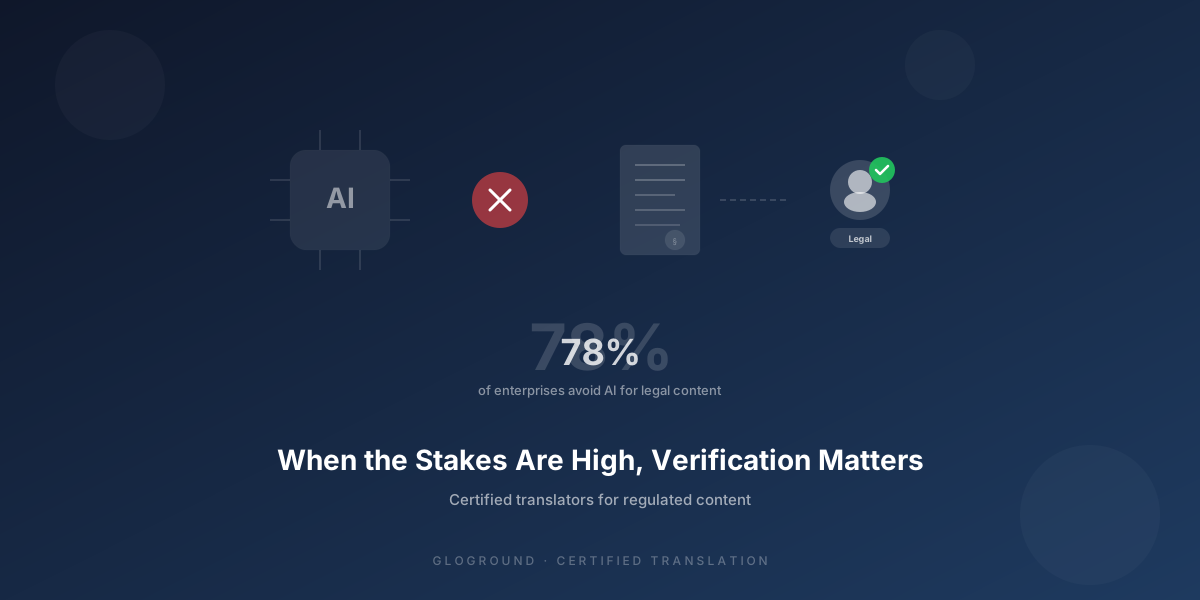
78% of Enterprises Avoid AI for Legal Content. Here's Why
In a 2026 survey of 152 enterprise teams, 78.3% said they would not use external AI translation tools for legal or contractual content.
That does not mean AI has no place in translation. It does mean that when the document carries legal, regulatory, or business risk, convenience alone is not enough. Teams still need confidence in the final wording, the context behind key terms, and the accountability of the person responsible for the work.
That distinction matters more than ever.
AI translation tools have improved quickly. They are fast, accessible, and often useful for internal communication, first drafts, and repetitive content. But "useful" and "safe to rely on" are not the same thing. In the same survey, 20.4% of enterprise teams said they had already experienced quality incidents after adopting AI translation. For many companies, stronger human review only became a priority after something went wrong.
That pattern is familiar across regulated industries. The issue is rarely whether AI can produce readable output. The issue is whether that output can be trusted in situations where a small error can create a contract dispute, a compliance problem, a failed submission, or a damaged customer relationship.
For teams working with legal, medical, financial, or other high-risk content, that is the real decision: not whether AI is good or bad, but whether the quality assurance behind the translation matches the risk of the document.
When AI Translation Works — And When It Doesn't
AI translation can be genuinely helpful in the right context.
It works well for internal notes, informal communication, rough summaries, large volumes of repetitive text, and early-stage drafts that will still go through careful review. In these cases, speed often matters more than stylistic precision, and the cost of a minor wording issue is relatively low.
That is why many companies continue to use AI in some part of their multilingual workflow.
But there is a clear line between low-risk and high-risk content.
Legal contracts, compliance documents, consent forms, financial disclosures, regulatory submissions, and clinical materials are not just language tasks. They are documents where wording carries consequences. A phrase that looks "close enough" in one language may create ambiguity, weaken enforceability, or change the practical meaning of an obligation in another.
This is also why 75.7% of companies in the same survey reportedly required human review even when AI was used. That response is telling. Most enterprise teams are not rejecting AI outright. They are putting controls around it.
That is the more realistic picture of the market.
AI is becoming part of the process, but it is not replacing the need for expert judgment in high-stakes work. In regulated environments, translation is still a quality assurance problem before it is a speed problem.
The Real Cost of "Good Enough" Translation
A translation does not have to be completely wrong to become expensive.
In legal content, a slightly imprecise term can change how a clause is interpreted. In medical content, a poorly rendered instruction can create patient safety concerns or invalidate part of a process. In financial or regulated communication, unclear wording can trigger review delays, internal confusion, or questions from external partners and regulators.
These are not theoretical risks. They are the reason buyers behave differently once the content becomes sensitive. We explored this pattern in more detail in Your Company Is Losing Money on Translation. You Just Don't Know How Much Yet.
At first glance, specialized human translation can seem expensive compared with general translation or AI-assisted output. General translation may fall in the range of $0.08 to $0.12 per word, while specialized work may reach $0.30 to $0.50 per word depending on the domain, language pair, and level of expertise required.
But that price difference exists for a reason.
You are not only paying for bilingual ability. You are paying for subject-matter familiarity, terminology control, judgment, and the ability to notice when a sentence is technically grammatical but still wrong in context. That difference is easy to overlook before the project begins and very difficult to fix after delivery.
This is where many procurement decisions go off track. Teams compare translation options as if they are buying the same service at different price points. In reality, they are often comparing entirely different levels of risk control.
For high-volume, low-risk content, "good enough" may be a reasonable standard.
For regulated content, "good enough" can become the most expensive option in the process.
What the 78% Are Doing Instead
If most enterprises are not comfortable using external AI translation tools for legal content, what are they doing instead?
They are moving toward verified expertise.
That means choosing translators whose capabilities can be checked before the project starts, rather than relying on self-reported fluency or a generic claim of experience. The trust gap in translation hiring — where every profile looks equally confident but actual qualifications vary widely — is something we examined in You Hired a Translator You Couldn't Verify.
It also means looking beyond the language itself and asking whether the translator is qualified for the specific type of content involved.
A bilingual professional is not automatically the right fit for a legal contract. A strong generalist is not automatically the right fit for medical documentation or financial compliance text. Buyers in regulated industries increasingly need a way to confirm three things in advance:
- that the translator actually works at a professional level in the target language
- that the translator is competent in the specific translation pair required
- that the translator has relevant specialization for the subject matter
This is exactly where certification and pre-verification become useful.
On GloGround, translators do not receive a certification badge by simply creating a profile and listing their skills. Certification is based on a two-step process: a Native Language Test and a Translation Pair Test. That structure is designed to help clients verify language quality more meaningfully before hiring.
The platform also supports matching by specialization, with more than 20 areas of expertise available. That matters because the question is rarely just "Can this person translate?" It is "Can this person translate this kind of document, in this language pair, at the level this project requires?"
For buyers, that difference reduces guesswork.
Instead of sorting through broad claims like "I can do everything," teams can look for visible indicators of fit: verified certification, specialization alignment, and a quality history supported by client reviews. For a practical walkthrough of what to look for, How to Hire a Qualified Translator covers the evaluation process in more detail.
Why This Matters for Your Next Translation Project
The practical question for enterprises is not whether to choose AI or humans as if they are mutually exclusive options.
The better question is this: what level of quality assurance does this content require?
For internal summaries, repetitive support content, or early-stage drafts, AI may be perfectly useful. For documents that carry legal obligations, regulatory impact, medical risk, or reputational exposure, the standard needs to be different.
In those cases, the safer workflow usually starts with a qualified human expert or ends with a level of human review that is strong enough to carry accountability.
That is where many teams are adjusting their approach. They are not abandoning technology. They are becoming more precise about when automation helps and when verification matters more.
If your next project involves regulated content, the goal is not simply to find someone who speaks two languages. It is to find someone whose ability, specialization, and translation competence can be checked before the work begins.
Search for certified translators on GloGround: Find a Translator
Frequently Asked Questions
Is AI translation good enough for business documents?▼
AI translation can be useful for internal communication, rough drafts, and high-volume repetitive content. But for legal, medical, financial, or other regulated documents, the right decision depends on the business risk of the content.
How many companies have had AI translation quality issues?▼
In a 2026 survey of 152 enterprise teams, 20.4% reported experiencing quality incidents after adopting AI translation tools.
What makes a certified translator different from a bilingual freelancer?▼
A certified translator has gone through a formal process to verify language ability and translation competence. On GloGround, certification includes both a Native Language Test and a Translation Pair Test.
How can I find a translator for regulated content?▼
Look for verified language-pair competence, relevant domain specialization, and a visible record of quality. On GloGround, you can filter translators by language pair, specialization, rating, and certification status.
Related Posts
95 Days. €15 Million. The EU AI Act Compliance Risk Hiding in Your Translated Docs.
The EU AI Act enforcement deadline is August 2, 2026. AI-translated compliance documents may not meet the Act's audit and transparency requirements. Here is what businesses need to know — and what to do in the next 95 days.
81% of Agency Translators Are Pressured to Cut Rates. Guess Whose Project Pays the Price.
When agencies pressure translators on rates, the cost does not disappear — it shows up as quality risk on your project. Here is what the data says about agency rate compression and what direct hiring actually changes.
Why Translation Quotes Vary So Much for the Same Project
Two quotes for the same translation project can look confusingly far apart. Here is what clients are actually paying for — and how to choose based on fit, not guesswork.