81% of Agency Translators Are Pressured to Cut Rates. Guess Whose Project Pays the Price.
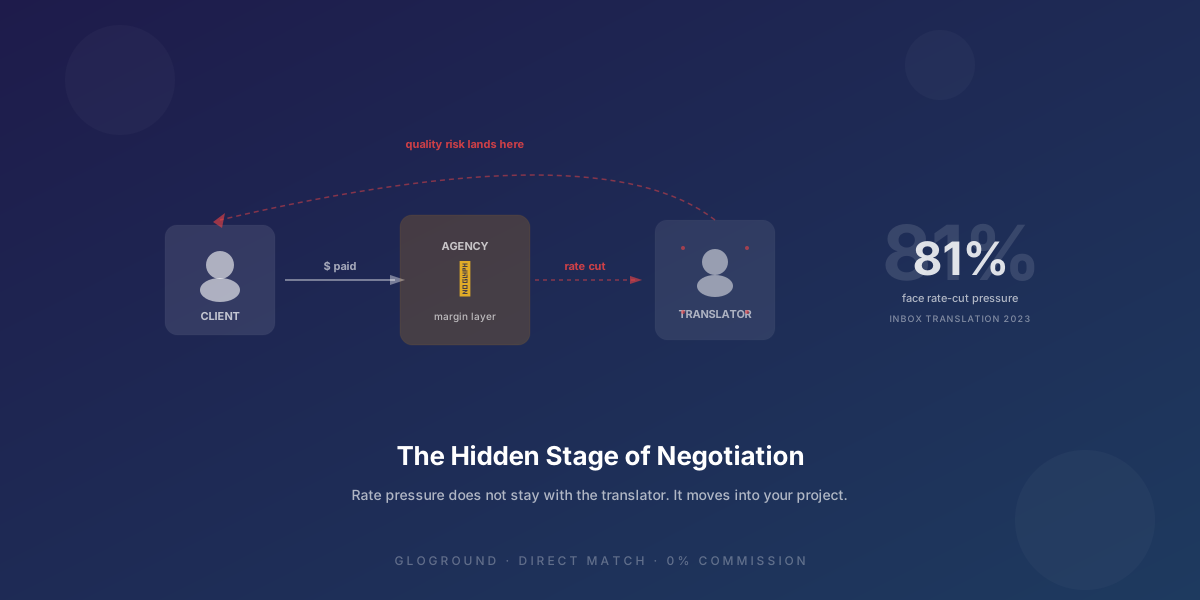
TL;DR: Inbox Translation's 2023 survey shows that most translators working with agencies face rate-cut pressure. That pressure does not stay with the translator — it becomes time pressure, reduced review, and quality risk on the client's project. Direct hiring removes the margin layer that drives much of the compression.
81% of Agency Translators Are Pressured to Cut Rates. Guess Whose Project Pays the Price.
When an agency wins your translation contract, the rate negotiation does not stop there. It continues downstream — with the linguist actually doing your work.
According to Inbox Translation's 2023 industry survey of 2,803 freelance translators, 48% of translators working with agencies said agencies often or always ask them to lower their rates, and another 33% said this happens sometimes. In other words, 81% reported some level of rate-cut pressure. The same survey found that low rates of pay were the most commonly reported difficulty of working with agencies, cited by 71% of agency-facing respondents.
That matters more to your project than it may seem.
Because price pressure does not disappear when it reaches the translator. It usually turns into something else: less time, less review, more compromise, more acceptance of workflows that would not be chosen under healthier conditions. And eventually, that shows up in the version you receive.
This is not an argument that every agency delivers poor work. Plenty do not. It is an argument that the economics of the model affect the conditions under which the work gets done. If you buy translation through an intermediary, it is worth asking what happens after the agency says yes to your budget.
The Hidden Stage of Negotiation
Most clients see only the first negotiation.
They discuss timing, scope, price, maybe a few service levels. The assumption is that once the contract is agreed, the work moves into execution.
But there is often a second negotiation the client never sees.
The agency has to preserve margin. That means the translator's rate is not simply "the project rate." It is the remaining rate after the intermediary layer takes its share. The 2023 Inbox Translation survey shows a broad gap in what freelancers report earning across client types: median per-word rates ranged between GBP 0.071 and 0.10, and median hourly rates between GBP 26 and 40, depending on the type of work and client relationship. The same report also found that direct clients were strongly associated with higher rates of pay and easier communication.
This is why agency rate compression is not an abstract industry complaint. It changes the working conditions of the person touching your file.
And when rate pressure becomes normal, translators adapt. Not because they are careless, but because the model encourages them to.
Why Rate Pressure Turns Into a Quality Problem
A translator who is pressured on rate still has the same document in front of them. The same terminology issues. The same unclear source segments. The same need for judgment.
What changes is the amount of time they can realistically spend.
Sometimes that means faster turnaround achieved by cutting back on self-review. Sometimes it means accepting more MTPE than they otherwise would. Sometimes it means not stopping to chase a nuance, not raising a clarification, not checking a term one more time. Sometimes it means the work gets routed to a more generalist linguist because the true specialist would not accept the agency's economics.
None of those decisions necessarily show up as dramatic failure.
More often, they show up as something quieter: a translation that is passable, but thinner than it should be. Less precise. Less alive to context. Less well-fitted to the market, the user, or the legal purpose of the text.
That is the part clients rarely see clearly enough. You are not just buying "agency quality." You may be buying the output of a linguist working under compressed time conditions created by a rate conversation you were never part of.
The Cost That Never Appears on the Invoice
This is where procurement logic often breaks down.
A lower top-line price looks efficient. But translation quality problems rarely arrive in the form of a line item labeled "quality problems." They arrive as internal review loops, corrections, relaunches, customer confusion, or delayed approvals.
That is why the real cost usually shows up elsewhere.
Marketing sees it in weaker conversion because the copy feels translated instead of local. Product sees it in slower launches because regional teams need to intervene. Legal and compliance see it when terminology becomes inconsistent or a translated document is no longer comfortable to approve. The business pays, just not where it expected to.
If you want the fuller version of that argument, Your Company Is Losing Money on Translation. You Just Don't Know How Much Yet goes deeper into the hidden-cost side.
The important point here is simpler: when an agency protects margin by squeezing the linguist, the financial pressure does not vanish. It moves into your project.
What Direct Hiring Changes
Direct hiring does not solve every problem. But it changes one important thing immediately: the translator is no longer at the end of a margin chain.
That matters.
When the person doing the work receives the full project payment, the economics are cleaner. There is no second negotiation happening out of sight. The translator is pricing the work itself, not the leftover after intermediation.
That changes quality conditions in practical ways. It gives the linguist more room to review properly, more reason to ask clarifying questions, and more ability to hold a professional standard instead of quietly adapting to a compressed workflow.
It also changes who gets selected.
In an agency model, routing can be opaque. Clients may not know who actually received the assignment or whether the chosen linguist was the strongest specialist or simply the most workable option at the available margin. In a direct-match model, that ambiguity is reduced. The client can choose the translator, see the specialization, and evaluate the profile more directly.
That is the structural difference GloGround is built around: 0% commission, direct matching, two-step certification, and 20 specialization categories. The point is not just lower friction. It is more visible alignment between what the client is buying and who is actually doing the work.
The Better Question to Ask
This is not really a call to stop using agencies in every case.
It is a call to ask a better question.
Not just: What is the quoted price? But: Under what conditions is the translator actually doing my work?
That question gets you closer to quality than the invoice ever will.
If the answer includes rate pressure, limited review time, no direct clarification path, and opaque routing, that should matter. If the answer includes direct access to a certified specialist, transparent credentials, and a cleaner economic structure, that should matter too.
Because translation quality does not begin at delivery.
It begins much earlier — in the conditions under which the translator says yes.
If you want the trust side of that equation, You Hired a Translator You Couldn't Verify. Here's Why That Keeps Happening is the natural companion piece. And if you are evaluating alternatives practically, How to Hire a Qualified Translator is the best next step.
What to Do Next
The goal is not to turn every client into a critic of agencies.
It is to make the hidden part of the model visible.
Because once you see where rate pressure really lands, you can make a better decision about where your quality risk is coming from — and what kind of hiring structure gives your project a better chance from the start.
Search for certified translators on GloGround: Find a Translator
Frequently Asked Questions
Why do agency translators work for less than direct clients?▼
Agencies have to protect their margin, so the rate the translator sees is the project rate minus the intermediary's share. Inbox Translation's 2023 survey of 2,803 freelance translators found that 81% of agency-facing translators face rate-cut pressure, and direct clients consistently pay more for the same work.
How does translator rate pressure affect my project quality?▼
Compressed rates usually translate into compressed time. Translators under pressure tend to shorten self-review, accept more machine-translation post-editing, and stop chasing the small judgment calls that make a translation feel native. None of that shows up on the invoice, but it shows up in the final text.
What is the price difference between direct and agency translation?▼
Inbox Translation's 2023 survey reports median per-word rates between GBP 0.071 and 0.10, and median hourly rates between GBP 26 and 40, depending on client type and assignment. Direct clients sit on the higher end of those ranges. Agency clients sit on the lower end.
How does GloGround prevent this rate pressure?▼
GloGround connects clients and translators directly, with 0% commission. The full client payment reaches the translator, so there is no second negotiation happening behind the scenes. Clients choose a verified specialist themselves, rather than receiving whoever the agency assigns.
Related Posts
Why Translation Quotes Vary So Much for the Same Project
Two quotes for the same translation project can look confusingly far apart. Here is what clients are actually paying for — and how to choose based on fit, not guesswork.
78% of Enterprises Avoid AI for Legal Content. Here's Why
Most enterprises already avoid AI translation for legal and contractual content. Here is what the data says about translation risk and why certified human translators still matter in regulated industries.
95 Days. €15 Million. The EU AI Act Compliance Risk Hiding in Your Translated Docs.
The EU AI Act enforcement deadline is August 2, 2026. AI-translated compliance documents may not meet the Act's audit and transparency requirements. Here is what businesses need to know — and what to do in the next 95 days.