Why Translation Quotes Vary So Much for the Same Project
TL;DR: A higher translation quote does not automatically mean better quality, and a lower quote does not automatically mean higher risk. The real question is who will do the work, whether their specialization fits your content, and whether their quality can be verified before you hire.
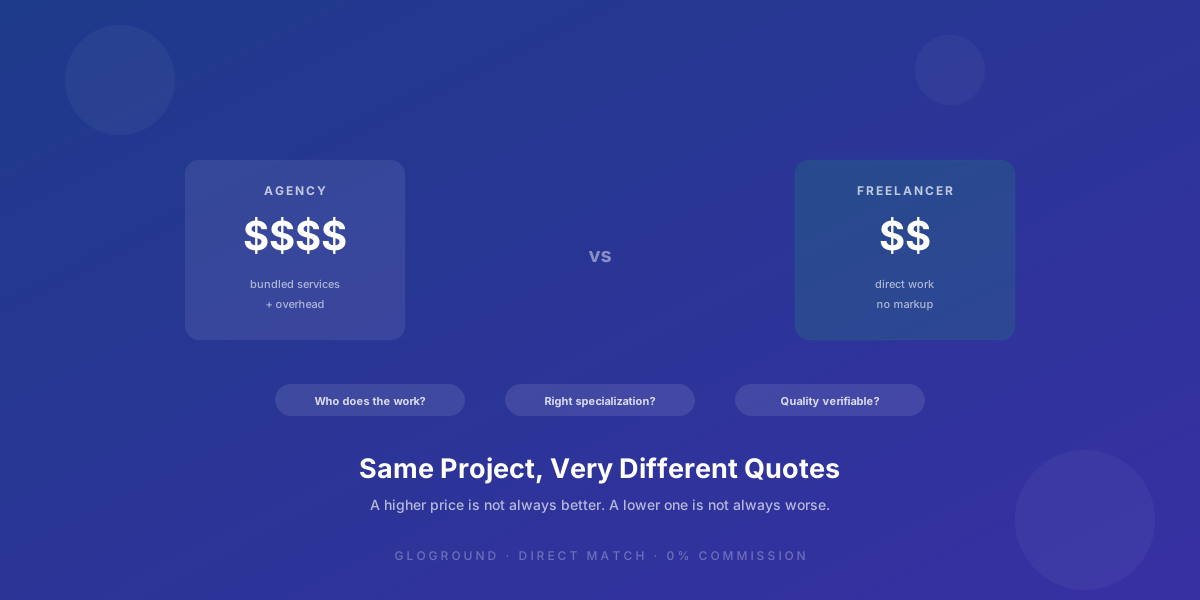
Why Translation Quotes Vary So Much for the Same Project
You send out the same translation brief to two providers.
One quote comes back from an agency. It is polished, organized, and more expensive than you expected. The second comes from a freelance translator. It is much cheaper. The freelancer seems qualified. The agency seems safer.
And now you are stuck.
If you choose the agency, are you paying for quality — or just overhead? If you choose the freelancer, are you being smart with budget — or taking a risk you cannot see yet?
This is one of the most common decision points for clients who buy translation. It feels like a pricing problem, but it is really a visibility problem.
You are not just trying to choose a price.
You are trying to understand what is inside the price.
The Quote Spread Is Real
Translation pricing can vary a lot, even for the same document.
That does not mean someone is necessarily overcharging. It also does not mean the cheaper option is automatically cutting corners. It usually means the two quotes are built on different cost structures.
Recent pricing references show the spread clearly. Direct client rates are typically 30-60% higher than agency subcontractor rates for the same freelancer doing the same language pair. Agency markup over the base freelancer cost typically runs 10-40%, with 20-30% being common.
There are also typical range differences. One 2026 pricing guide places freelancers around $0.10 per word for general translation and around $0.14 per word for technical content, while agencies often quote around $0.14-$0.18 per word. Another pricing guide puts professional human translation in the U.S. at roughly $0.15-$0.30 per word, depending on the work.
So yes, the spread can be meaningful.
A startup founder might see a solo linguist quote a per-word price about 30% cheaper than an agency for the same project. That does not automatically tell you who is right. It tells you that the buying question needs to get more specific.
What is included? Who is doing the work? What level of review is being provided? Does the person handling the translation actually fit the subject matter?
Those questions matter more than the headline price.
Why Agencies Often Cost More
It is easy to look at the higher agency quote and assume the difference is just markup.
Sometimes part of it is. But that is not the whole story.
Agencies often cost more because they include services around the translation itself. That may include project management, scheduling, second-pass editing, quality review, file engineering, liability coverage, payment security, vendor coordination, and time-zone coverage.
For larger companies, those layers can be useful.
If you have a multilingual product launch, a dozen file formats, urgent delivery, multiple stakeholders, and internal reviewers in different regions, the agency may be solving an operational problem, not just a language problem.
That work has value.
The important point is this: an agency quote is not always "the translator's price plus extra." It may be a bundled service model. You may be paying for coordination, risk absorption, review structure, and convenience.
That can be worth it.
But it is not always necessary.
If your project is focused, your language pair is clear, and you mainly need one qualified specialist, the extra structure may not improve the final result enough to justify the difference.
This is why comparing agency and freelancer quotes line by line can be misleading. You may not be comparing the same product.
You may be comparing a managed workflow to a direct specialist relationship.
Why Cheaper Does Not Automatically Mean Worse
A lower freelancer quote can make clients nervous.
That is understandable. Translation quality is hard to judge if you do not speak the target language. A low price can feel like a warning sign, especially if the content matters.
But a cheaper quote is not automatically worse.
Sometimes it is cheaper because there is no agency layer. The translator is not receiving the leftover amount after margin is taken. They are quoting directly for the work they will personally do.
That can create a cleaner relationship.
You know who is handling the document. You can ask questions directly. You can clarify tone, audience, terminology, deadline, and purpose without everything passing through a middle layer.
The risk is not that the person is a freelancer.
The risk is that you cannot verify whether they are the right freelancer.
That distinction matters.
A solo translator with relevant specialization and strong credentials may be a better fit than a generalist routed through an agency workflow. A freelancer without relevant experience, however, may create rework, delay, and confusion.
The business risk is not "agency versus freelancer."
It is verified fit versus guesswork.
If this is your first time building a hiring process, How to Hire a Qualified Translator: A Client's Complete Guide is a good place to start.
The Three Questions That Matter More Than Price
When two quotes are far apart, do not begin by asking which one is "fair."
Start with three better questions.
1. Who is actually doing the work?
This sounds basic, but it is often the most important question.
With an agency, you may not know who the final linguist is until later, or sometimes at all. That does not mean the work will be poor. It just means you are trusting the agency's internal selection process.
With a freelancer, you usually know exactly who is doing the work. That can be an advantage, if you can evaluate the person properly.
Ask what role each person plays. Who translates? Who reviews? Who answers questions? Who owns the final quality?
A quote becomes easier to understand once the workflow is visible.
2. Does their specialization match your content?
Translation is not one skill.
A marketing page, medical report, legal document, game script, investor deck, product manual, and support article all require different judgment.
This is one reason prices vary. Specialization has real economic weight. General work may sit around $15-$30 per hour, while legal or medical specialists can command $75+ per hour.
That premium is not just about vocabulary. It reflects domain knowledge, risk, accuracy, and the cost of getting things wrong.
If you are translating a campaign tagline, you need someone who understands audience and persuasion. If you are translating a legal notice, you need someone who understands precision and consequence.
The cheapest qualified translator may be a good choice.
The cheapest mismatched translator usually is not.
3. Can their quality be verified?
This is the part clients struggle with most.
A profile can say "professional." A proposal can say "native-level." A quote can say "high quality." None of that tells you much on its own.
Look for proof.
Certification. Relevant specialization. Reviews. Prior experience with similar content. Clear communication. A willingness to ask thoughtful questions before starting.
The more important the content, the more these signals matter.
This is also why rate compression can become a quality issue. When translators are squeezed too hard inside agency or subcontracting models, the pressure can affect time, review, and attention. We unpack that more in 81% of Agency Translators Are Pressured to Cut Rates. Guess Whose Project Pays the Price.
The point is not to avoid agencies. It is to understand the conditions under which your translation is actually being produced.
Urgency Changes the Quote, Too
There is one more factor clients often underestimate: time.
Rush projects cost more for a reason. Urgent translation commonly adds 25-100% to the price, depending on deadline pressure, availability, and complexity.
That can be frustrating when you are already under pressure. But it is not arbitrary.
A rush request may require the translator to rearrange other work, work outside normal hours, or reduce the time available for careful review. If a provider promises a very fast turnaround at a very low price, that is worth examining carefully.
Sometimes speed is necessary.
But if quality matters, the quote should reflect the conditions required to produce it well.
How Direct Matching Removes Some of the Guesswork
This is where GloGround's model is designed to help.
GloGround connects clients directly with certified freelance translators. Instead of comparing an agency quote and an anonymous freelancer quote, you can search for the actual specialist you need.
You can filter by language pair, specialization, and verified certification.
That changes the buying process.
You are not only asking, "Which quote is cheaper?" You are asking, "Which certified translator is the best fit for this content?"
GloGround's certification has two steps: the Native Language Test and the Translation Pair Test. These help create a stronger signal than a self-written profile alone.
The platform also supports 20 specialization categories, including Legal, Medical, Technical, Marketing, Gaming, Finance, and more. That matters because the right category can change the quality of the result.
And because GloGround uses a 0% commission model, translators keep 100% of the project payment. For clients, that means there is no agency markup built into the relationship. The payment goes directly to the person doing the work.
That does not mean every project should avoid agencies.
It means clients have another option when they want direct visibility, verified credentials, and a clearer connection between price and expertise.
If your main concern is whether the translator is actually qualified, You Hired a Translator You Couldn't Verify. Here's Why That Keeps Happening goes deeper into that trust gap.
A Better Way to Read the Quote
The next time two translation quotes land far apart, try not to treat the price as the answer.
Treat it as the beginning of the question.
A higher quote may include useful operational support. A lower quote may be more efficient because the specialist is working directly. Either can be right. Either can be wrong.
The difference comes down to fit.
Who is doing the work? Does their specialization match the content? Can you verify their quality before the project begins?
Once you can answer those questions, the decision becomes calmer.
You are no longer choosing between "expensive and safe" or "cheap and risky."
You are choosing the structure that gives your project the best chance of being done well.
Start With the Translator, Not the Quote
If the content matters, start by finding the right person.
Then evaluate the price in context.
That small shift can save a lot of second-guessing. It helps you avoid paying extra for layers you do not need, while also avoiding the false economy of hiring someone who is not suited for the work.
The best translation decision is not always the cheapest one.
It is the one where the value is visible before you say yes.
Search for certified translators on GloGround: Find a Translator
Frequently Asked Questions
Why are translation quotes so different for the same project?▼
Quotes vary because providers include different things: project management, editing, quality review, file preparation, rush handling, liability coverage, or direct translator work only. The price difference is not always a quality difference.
Is an agency quote always better than a freelancer quote?▼
Not always. Agencies can be valuable when you need coordination, multiple languages, added review layers, or operational support. A certified freelance specialist may be a better fit when you want direct communication and clearer visibility into who is doing the work.
Is a cheaper freelancer quote a red flag?▼
Not by itself. A lower quote may simply mean there is no agency markup. What matters is whether the translator has relevant specialization, verified credentials, clear communication, and experience with your type of content.
How does GloGround help clients compare translation options?▼
GloGround lets clients search directly for certified freelance translators by language pair, specialization, and verified certification. This makes it easier to evaluate the actual person doing the work instead of comparing opaque quotes.
Related Posts
81% of Agency Translators Are Pressured to Cut Rates. Guess Whose Project Pays the Price.
When agencies pressure translators on rates, the cost does not disappear — it shows up as quality risk on your project. Here is what the data says about agency rate compression and what direct hiring actually changes.
95 Days. €15 Million. The EU AI Act Compliance Risk Hiding in Your Translated Docs.
The EU AI Act enforcement deadline is August 2, 2026. AI-translated compliance documents may not meet the Act's audit and transparency requirements. Here is what businesses need to know — and what to do in the next 95 days.
78% of Enterprises Avoid AI for Legal Content. Here's Why
Most enterprises already avoid AI translation for legal and contractual content. Here is what the data says about translation risk and why certified human translators still matter in regulated industries.