5x More Content, Same Budget: The Localization Squeeze of 2026
TL;DR: Enterprise teams are being asked to produce far more localized content while budgets remain flat. AI can help with low-risk content, but plausible-but-wrong output creates hidden risk in legal, marketing, product, and customer-facing materials. The smarter move is not AI versus human — it is knowing where verified human specialists matter most.
5x More Content, Same Budget: The Localization Squeeze of 2026
You probably know the meeting before it happens.
Growth wants more markets. Marketing wants more campaign variants. Product wants faster release notes, help content, onboarding flows, and app copy in more languages. Legal wants consistency. Customer success wants everything live yesterday.
Then finance says the budget is staying flat.
That is the localization squeeze of 2026.
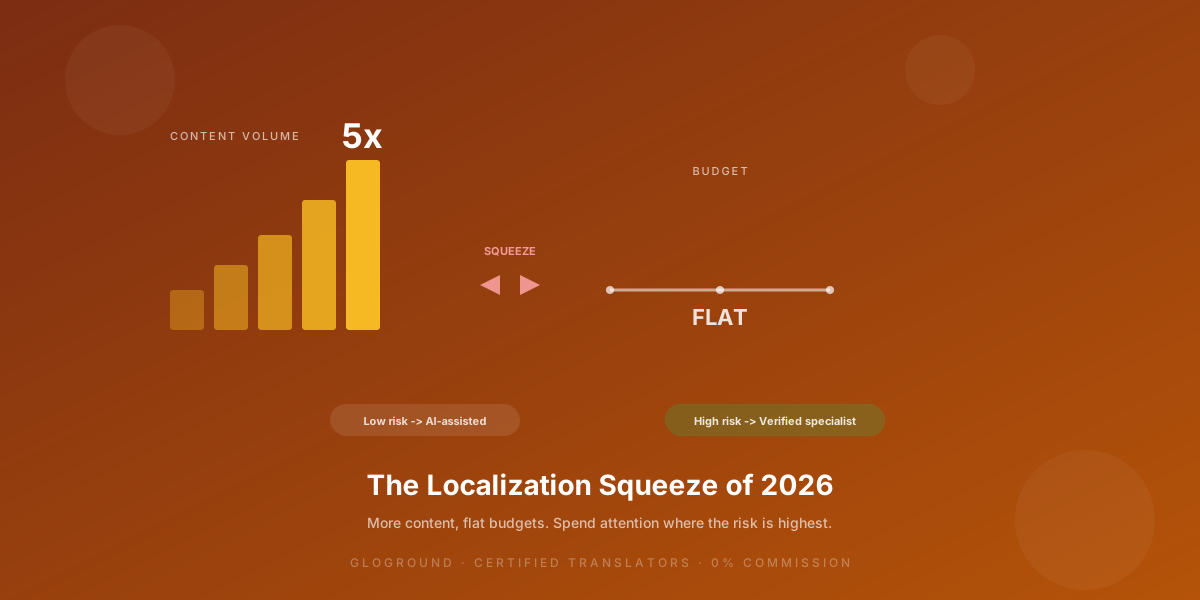
Enterprise teams are not being asked to do a little more with a little less. They are being asked to scale dramatically without changing the cost structure underneath. One recent industry report found that 65% of enterprise leaders already run AI in core localization workflows, while 40% expect budgets to stay flat even as they are asked to scale output 5x.
You can understand why AI translation became the obvious answer.
It is fast. It is available. It helps teams move volume that would otherwise be impossible. For many low-risk content types, that is useful.
But the real question is not whether AI belongs in localization. It already does.
The harder question is where it should stop.
The Problem Is Not Volume. It Is Risk.
Most localization teams are now managing two problems at once.
The first is obvious: content volume keeps growing. Every new market multiplies the number of assets that need translation. Every product update creates more strings, emails, support pages, sales decks, and customer notices.
The second problem is quieter: not all content carries the same risk.
A low-visibility internal note is not the same as a pricing page. A support article is not the same as a legal disclosure. A draft social post is not the same as a product claim, an HR policy, a medical instruction, or a contract clause.
Yet under budget pressure, these differences often get flattened.
Everything becomes "content." Everything gets routed through the fastest workflow. The team celebrates throughput, at least for a while. Then the hidden costs begin to show up.
A regional reviewer flags tone problems. A product page sounds fluent but confusing. A campaign line does not land in-market. A legal phrase reads smoothly but changes the implication. A customer-facing page technically says the right thing, but not in a way people trust.
That is when translation stops being a production issue and becomes a business issue.
We covered that broader cost problem in Your Company Is Losing Money on Translation. You Just Don't Know How Much Yet. The short version is simple: the invoice is rarely the full cost. Rework, delay, and trust erosion usually arrive later.
AI Helps With Scale. It Does Not Remove Judgment.
The industry has clearly moved past the "will AI be used?" stage.
According to Slator's 2026 market reporting, 74% of language service providers now describe themselves as operational, active, or systemic with AI, up from just 6% three years ago. That is not a small adoption curve. It is a market reset.
For buyers, this means AI is already inside many localization workflows whether or not it is visible in the proposal.
That is not automatically bad.
AI can help create first drafts. It can support large-volume workflows. It can make low-risk content more manageable. It can help teams avoid bottlenecks when the alternative is not "perfect human translation," but "nothing gets localized at all."
The problem starts when AI output is treated as finished work.
Especially when nobody has decided which content deserves a human specialist, which content only needs light review, and which content should never be shipped without domain expertise.
That distinction matters because AI translation failures are not always obvious.
Lilt's GAIA-v2 benchmark found that nearly 20% of AI translation failures in Arabic and Korean come from translation artifacts — output that is grammatically correct but logically confusing. That is exactly the kind of error that can slip through a rushed review.
It does not look broken at first glance.
It just does not quite make sense.
The Hardest Errors Are the Ones That Sound Fine.
Bad translation used to be easier to spot.
The grammar was strange. The wording was stiff. The sentence clearly sounded translated. Someone on the team would notice, even if they could not fix it themselves.
AI has changed that.
Now the output can sound polished while still being wrong.
That is more dangerous in a business setting because fluent language creates confidence. It makes reviewers move faster. It makes teams assume the risk has gone down when, in some cases, it has simply changed shape.
An October 2025 study reported AI translation hallucination rates of 33% to nearly 60%, depending on model and language pair. That number should not lead to panic, but it should change how buyers think about review.
The issue is not that AI always fails. It is that when it fails, it may fail in ways your workflow is not designed to catch.
A hallucinated detail in a low-risk draft may be annoying. A hallucinated detail in regulated content is a different matter. A confusing artifact in an internal memo may be manageable. The same kind of artifact in onboarding, product safety, finance, healthcare, legal, or public-facing brand content can create much bigger problems.
This is why many enterprises are drawing a sharper line around sensitive content. As we discussed in 78% of Enterprises Avoid AI for Legal Content. Here's Why, the hesitation is not anti-technology. It is risk management.
You do not need to distrust AI to know that some content needs accountable human judgment.
Smart Buyers Are Not Choosing AI or Human. They Are Triaging.
The best localization buyers in 2026 are not asking, "Should we use AI?"
They are asking, "Where is AI enough, and where do we need a verified specialist?"
That is a better question.
For low-risk, high-volume content, AI-assisted workflows may be practical. You can move faster. You can cover more surface area. You can reserve budget for the places where mistakes would cost more.
For high-stakes content, the logic changes.
You need someone who understands not only the language, but the field. Marketing copy needs a translator who understands persuasion, tone, and market fit. Legal content needs someone who understands terminology and consequence. Medical, technical, gaming, financial, and product content each bring their own standards.
This is where budget discipline becomes more strategic.
Flat budgets do not mean every asset should receive the same level of care. They mean you need to spend attention where the risk is highest and the return is clearest.
That is also where localization ROI changes. A translated page that converts poorly is not a savings story. A cheaper workflow that delays launch is not efficient. A fluent but confusing product explanation can cost more than a stronger translation would have.
For a broader view of that growth logic, see $1 In, $25 Out: The Localization ROI Math Most Companies Are Getting Wrong.
The point is not to spend more everywhere.
It is to stop spending blindly.
What Changes When the Specialist Is Visible From the Start
This is where GloGround fits naturally into the 2026 localization problem.
Not as an anti-AI platform. That would miss the point.
GloGround is built for the part of the workflow where human expertise needs to be visible, searchable, and directly connected to the buyer.
Clients can search for translators by language pair, specialization, and verified certification. That matters because the buyer's real problem is often not "we need a translator." It is "we need the right translator for this type of content, and we need to know why we can trust them."
GloGround's certification process has two steps: the Native Language Test and the Translation Pair Test. Together, they help create a stronger signal than a self-written profile alone.
The marketplace also supports 20 specialization categories, including Legal, Medical, Technical, Marketing, Gaming, Finance, and more. That makes it easier to match high-risk or high-value content with people who are positioned for that field.
And because GloGround is a 0% commission marketplace, translators keep 100% of the project payment. For clients, that means the model avoids agency markup and keeps the relationship more direct. You know who is doing the work. The translator knows what you need. The budget is less diluted by layers in the middle.
That structure matters when budgets are flat.
It helps clients use human expertise more precisely, instead of spreading it thin or hiding it behind opaque workflows.
The Better 2026 Localization Model
The companies that handle this moment well will not be the ones that translate everything manually.
They will not be the ones that automate everything either.
They will be the ones that build a smarter split.
AI for speed where the stakes are low. Verified human specialists where the stakes are high. Direct matching when expertise matters. Clear ownership when the final words need to stand up to customers, regulators, partners, or market scrutiny.
That is the practical middle ground.
It is not dramatic. It is not anti-AI. It is simply a more honest way to handle the work enterprises are now being asked to do.
Because 5x more content with the same budget is possible only if you stop treating all content as equal.
Some content can be scaled.
Some content needs to be trusted.
Start With the Content That Matters Most
If your team is under pressure to localize more this year, start by sorting your content into risk tiers.
What can be handled through AI-assisted workflows? What needs human review? What needs a certified specialist from the beginning?
That one exercise can make the budget conversation clearer.
You may not need more spend across the entire localization operation. You may need a better way to direct the spend you already have toward the content that carries the most risk and value.
That is where a certified specialist can make the difference.
Search for certified translators on GloGround: Find a Translator
Frequently Asked Questions
Should enterprises stop using AI translation?▼
No. AI translation can be useful for low-risk, high-volume content. The risk comes when companies use AI output without verified human review for content where accuracy, tone, legal meaning, or customer trust matters.
What is the main localization challenge in 2026?▼
Many enterprise teams are being asked to scale output dramatically while budgets stay flat. That creates pressure to rely on AI, but it also increases the need to separate low-risk content from high-risk content that requires certified specialists.
Why is plausible AI output risky?▼
The hardest AI translation errors are often not obvious grammar mistakes. They are fluent sentences that carry the wrong logic, tone, implication, or terminology. These can be difficult for non-native reviewers to catch.
How does GloGround help localization buyers?▼
GloGround lets clients search directly for certified freelance translators by language pair, specialization, and verified certification. This helps buyers reserve expert human review for the content where quality risk is highest.
Related Posts
78% of Enterprises Avoid AI for Legal Content. Here's Why
Most enterprises already avoid AI translation for legal and contractual content. Here is what the data says about translation risk and why certified human translators still matter in regulated industries.
70% of Freelance Translators Lost Work Last Year. The Other 30% Chose a Different Path.
The translation market is still growing, but many freelance translators are seeing less work. Here is why generalist demand is shrinking, why specialized translators still earn a premium, and how certification can help you stand out.
Your Company Is Losing Money on Translation. You Just Don't Know How Much Yet.
The real cost of translation goes far beyond the invoice. Rework, delays, lost customers, and compliance risks add up fast. Here is how to avoid the most expensive mistakes.